
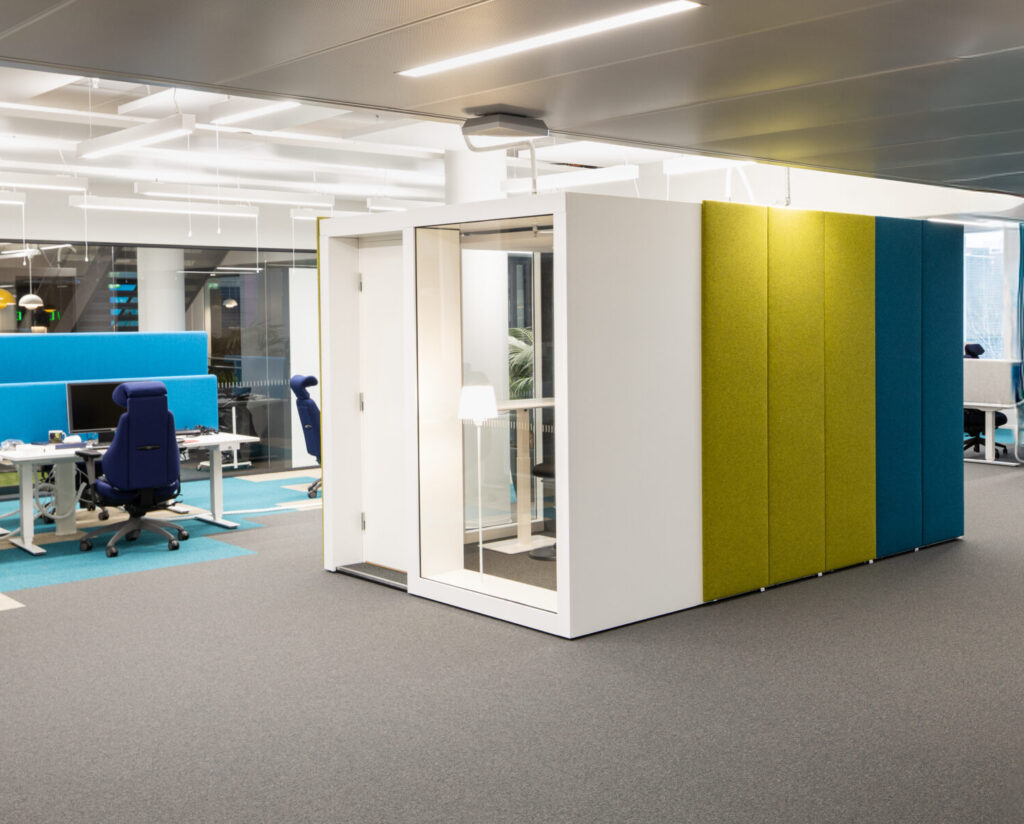
A soundproofed workspace is a specially constructed space that prevents sound from travelling from inside the space to the outside and vice versa. Such spaces, such as telephone booths and meeting rooms, provide a peaceful working environment in the middle of a busy office. Soundproofing is based on special material choices and structural solutions that dampen disturbing noises and enable concentrated work without background noise.
What does a soundproofed workspace mean in practice?
A soundproof workspace is a structurally designed space that prevents sound from travelling through the walls of the space in both directions. In practice, this means that telephone conversations or meetings held in the space cannot be heard outside, and external noise does not disturb work inside the space. Soundproofing works by using several layers of different materials that absorb and reflect sound.
A standard open-plan office or a space divided by partitions does not provide sufficient protection from noise. In a soundproofed space, speech can only be heard outside as a quiet and indistinct hum, whereas in a standard open-plan space, conversations can be heard over a wider area, causing a disturbance. High-quality soundproofing is equivalent to the soundproofing capacity of a traditional fixed meeting room.
There are several different soundproofing solutions for various purposes. Phone booths offer private space for phone calls and video conferences, while larger meeting rooms are suitable for team meetings. Retreat areas allow for concentrated work in peace and quiet. All these solutions are based on the same principle: preventing sound transmission through structural solutions.
Why does a soundproofed workspace improve well-being and productivity at work?
A soundproofed workspace significantly reduces noise pollution, which directly improves concentration and work efficiency. Constant background noise increases stress levels, causes fatigue and impairs the employee's ability to perform their tasks effectively. A peaceful working environment allows the brain to focus on what is important without constantly filtering out distractions.
The biggest challenges in open-plan offices are related to the sound environment and lack of privacy. Colleagues' phone calls, spontaneous conversations and general office noise constantly interrupt work. Soundproofed spaces solve this problem by providing a place where employees can make confidential phone calls or concentrate on demanding tasks without interruptions.
The psychological benefits of a quiet working environment are significant. Employees experience less stress when they can control their sound environment and choose when they need silence. Physiologically, constant noise raises cortisol levels and can cause long-term health problems. Quiet workspace supports both mental and physical well-being, which is reflected in improved job satisfaction and productivity.
How do you choose the right soundproofing solution for your office?
Choosing the right soundproofing solution starts with assessing your needs. Consider whether you need space mainly for phone calls, video conferences or long periods of concentrated work. A compact phone booth is sufficient for individual calls, while team meetings require a larger space where several people can work comfortably.
Size and placement are practical factors that affect the functionality of the solution. Estimate how many people will be using the space at the same time and how much floor space you can allocate. The layout of the office should be designed so that the spaces are easily accessible but do not interfere with other activities. Modular solutions allow for flexible placement and expansion if necessary.
With regard to technical characteristics, pay attention to ventilation, which guarantees freshness even during long periods of use. Lighting must be adequate and adjustable for different situations. Ergonomics are important if you spend long periods of time in the room. Also check that the space has sufficient electrical connections for your equipment and that the acoustic performance meets your office requirements.
What are the key technical features of a soundproofed workspace?
The effectiveness of sound insulation is based on material choices and structural solutions. High-quality soundproofed spaces use several layers of different materials, which together prevent sound transmission. The structure may include, for example, several layers of panels with sound-absorbing material between them. Textile surfaces and acoustic panels absorb sound and reduce reverberation within the space.
The ventilation system is a critical component that affects both user comfort and acoustic performance. Efficient and quiet ventilation ensures fresh air without disturbing background noise. The system must also provide sufficient air exchange during longer periods of use to keep the space comfortable and support concentration.
Acoustic performance is measured using several indicators. The speech transmission index (STI) indicates how clearly speech can be heard outside the room. High-quality sound insulation achieves an STI value of 0.10–0.15, which means that speech is barely audible outside the room. In practice, this guarantees privacy for confidential conversations. Decibel levels and sound attenuation through the structure are technical indicators that reveal the actual quality of sound insulation. High-quality sound insulation attenuates normal speech so that it does not disturb work outside the room.
Electrification and technology integration support modern working needs. Sufficient power sockets, USB connections and the possibility to connect monitors or other devices make the space versatile. Adjustable lighting and temperature control improve user comfort in different situations and seasons.
 Finnish
  English
  German
  Swedish
  French
  Spanish
  Italian
  Japanese