








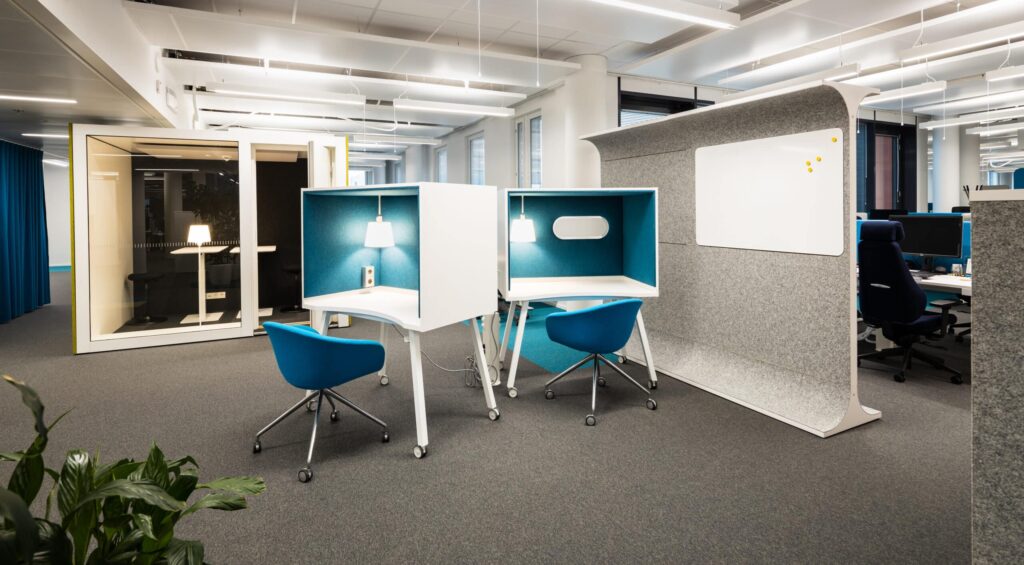
At its best, a multi-space office is a flexible environment where the space adapts to the various situations that arise during the working day. The same person might need a quiet place to concentrate in the morning, a small meeting room in the afternoon, and several private phone calls or video meetings throughout the working day.
When the working environment does not provide sufficient acoustic and visual privacy, day-to-day work suffers. The noise, background chatter, movement and constant interruptions in an open-plan office can make it difficult to concentrate. A soundproofed workspace provides a clear counterbalance to open-plan working in a multi-space office: a place where you can relax, speak in confidence and get on with your work without unnecessary noise.
Why does a multi-purpose office need quiet spaces?
The idea behind a multi-space office is not that everyone does everything in the same space. A well-designed office offers different zones for different needs: open-plan areas for collaboration, semi-public areas for brief meetings, and more private spaces for situations requiring concentration or privacy.
Soundproofed workspaces are important in this context, as they help to manage the office’s soundscape without having to completely rebuild the entire space. They can serve as quiet workstations, telephone booths, small meeting rooms or places to retreat to in the middle of the working day.
A soundproofed workspace is not just a telephone booth
Phone booth It’s a familiar solution to many, but a soundproofed workspace can mean much more than that. It can be a space for one person to concentrate, a space for two people to have a confidential conversation, or a small meeting room for spontaneous discussions.
The key point is that the space meets users’ actual needs. If there are a lot of short phone calls made in the office, a phone booth in the office may be the best initial solution. If, on the other hand, the need relates to project work, one-to-one discussions or video meetings for hybrid working, a larger POD space may be more suitable.
Where is the best place to set up a soundproofed workspace?
The layout has a decisive impact on how much space is used. A soundproofed workspace should be situated where the need for it arises naturally: close to workstations, but not in the middle of the busiest thoroughfare. This ensures the space is easily accessible, but its use does not cause further disruption to the surrounding area.
Good locations include, for example, the edges of open-plan offices, areas close to team workspaces, connections to lobbies and meeting spaces, and those spots where staff already tend to go to make calls or have a quiet chat.
Accessibility and ease of use are key
A good workspace is easy to start using. If the space is too far away, in an awkward location or feels uncomfortable, it will be used less often. Factors affecting user comfort include lighting, ventilation, furniture, acoustics, privacy screens and the proportions of the space.
A soundproofed workspace should not feel like a disjointed box, but should blend in with the office’s architecture and interior design. When the solution looks like a natural part of the whole, it also enhances the visual quality of the space.
How do soundproofed workspaces improve office acoustics?
Office acoustics are not achieved through a single product, but through a combination of several solutions. A soundproofed workspace is particularly beneficial in two ways: it reduces the amount of ambient noise entering the space and limits the sound of conversations within the space from carrying out.
This is particularly important when there is a lot of verbal communication in the office. Phone calls, video meetings and quick conversations can create a lot of noise in an open-plan office, even if individual conversations are not particularly loud. When some of these situations are moved to acoustically screened spaces, the soundscape in the open-plan area also becomes quieter.
Privacy is part of the quality of the working environment
Not all work is meant to be overheard. HR discussions, customer calls, financial matters, recruitment interviews and strategic meetings require a space where speech does not carry into the surrounding area. A soundproofed workspace promotes both concentration and confidentiality.
Privacy is also an experiential matter. When an employee knows they have a place for a quiet conversation, the pressure of the working day is eased. A good space means you don’t have to go looking for an empty meeting room, a stairwell or a corner of the corridor.
A soundproofed workspace as part of a flexible office
Today’s working environments are changing rapidly. Team sizes fluctuate, hybrid working is transforming the way space is used, and offices must cater for both collaboration and individual focus. That is why adaptable space solutions are needed alongside fixed building solutions.
Modular POD rooms and movable acoustic solutions offer flexibility. They allow quiet spaces to be added to the office without the need for major refurbishment. As the needs of the working environment change, these solutions can often be moved, expanded or rearranged.
One space, many uses
A soundproofed workspace can serve different users at different times. In the morning, it can be a place for deep concentration; during the day, a quiet phone booth; and in the afternoon, a small meeting room. This also makes the space efficient in terms of floor area.
A good multi-purpose office does not simply maximise the number of workstations. It optimises the usability of the space: how well the space supports the tasks that people carry out during the working day.
What should you bear in mind before making a purchase?
Before choosing a soundproofed workspace for your office, it is worth considering at least three things: what the space will be used for, how many people will need to use it, and what kind of layout will help ensure that day-to-day operations run smoothly.
A single-person telephone booth is ideal for short calls and video meetings. A larger POD space can also serve as a meeting room, a project space or a quiet workspace. If there are a lot of simultaneous calls in the office, several smaller spaces may be more practical than one large space.
Acoustics, ergonomics and aesthetics go hand in hand
A good solution isn’t just about being quiet. It must also be pleasant to use. Ergonomic furniture, good lighting, adequate ventilation and a well-considered choice of materials all contribute to whether a space feels like a genuinely high-quality working environment.
In an office inspired by Nordic design, a quiet workspace can be both a technical solution and an architectural feature. When the proportions, colours and materials are just right, a soundproofed workspace enhances both the peace and quiet of the workplace and the visual identity of the space.
In conclusion
A soundproofed workspace is one of the key features of a multi-space office. It helps to manage noise, enhances privacy and allows employees to choose a space suited to the task at hand. When quiet spaces are designed as part of the overall layout, the office better supports both concentration and collaboration.
The best working environments are neither completely open-plan nor completely enclosed. They strike a balance: spaces for interaction, spaces for concentration, and areas that adapt to the changing needs of work.