








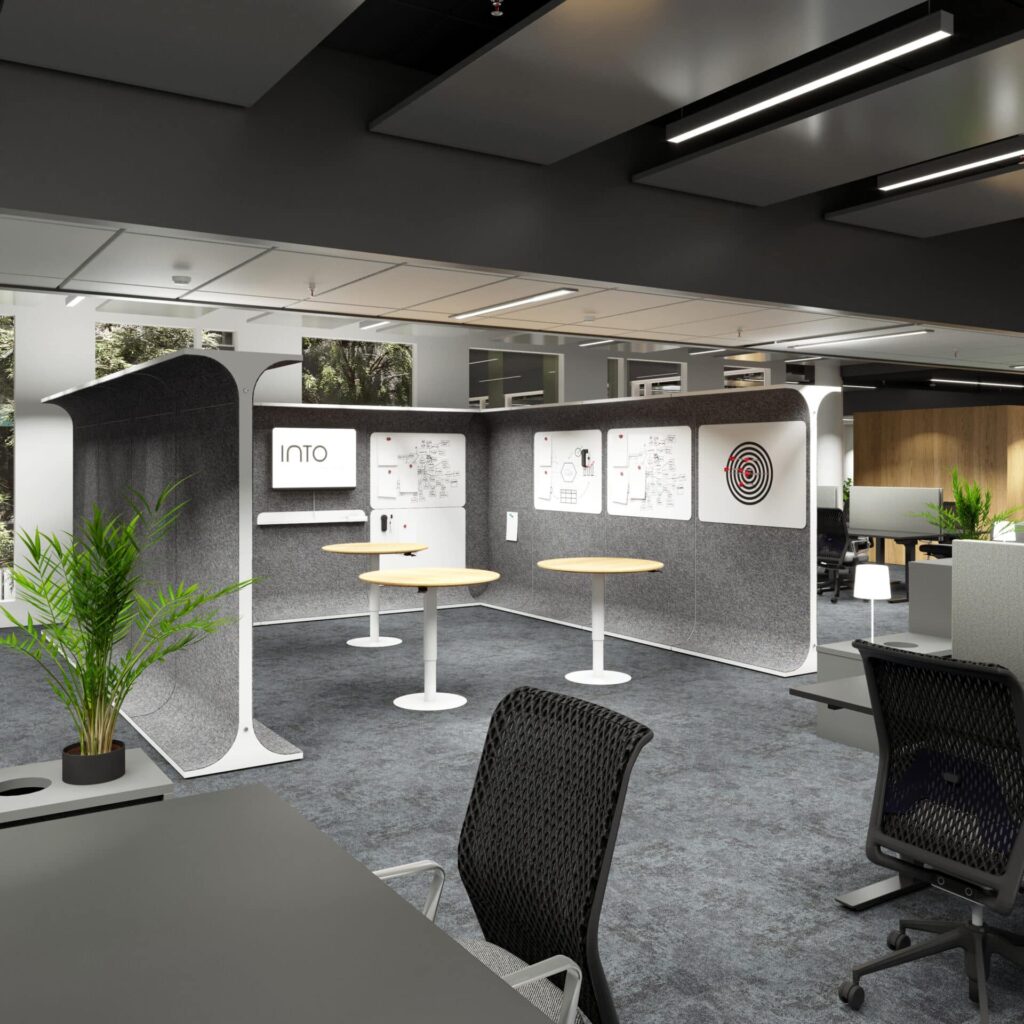
An open-plan office can foster collaboration, the rapid flow of information and a sense of community. At the same time, it is prone to noise. Conversation, phone calls, video meetings, the sound of footsteps, printers and constant movement can easily create background noise that makes it difficult to concentrate.
Noise in an open-plan office is not just a matter of comfort. It affects how well the space supports different types of work. If there isn’t enough acoustic variation in the office, all work takes place against the same background noise – including work that requires peace and quiet.
Good office acoustics are the result of a number of factors: spatial zones, materials, furniture, soundproofed workspaces and working practices that support users’ day-to-day lives.
First, identify the sources of the noise
Before choosing a solution, it is worth finding out where the noise is coming from. Often, the problem is not a single loud sound, but a constant combination of many small sounds. Background speech is particularly distracting, as people naturally pay attention to it.
Noise is often caused by the following situations:
- phone calls and video meetings at workstations
- spontaneous conversations in team areas
- through traffic next to workstations
- hard-surfaced materials and reverberant spaces
- insufficient number of meeting rooms
- unclear spatial zones
Once the sources of noise are identified, solutions can be targeted effectively. An open-plan office does not need to be turned into a quiet library, but it should offer options to suit different work situations.
Create clearly defined spatial zones
One of the most effective ways to improve office acoustics is to divide the space into functional zones. It is not advisable to carry out all activities in the same open-plan space. Collaboration, concentration, phone calls and meetings all require their own dedicated spaces.
A multi-purpose office works best when users can quickly understand where they can chat freely, where they can hold a short meeting, and where quieter work is expected. Clarity reduces conflicts and makes the space easier to use.
Acoustic barriers help without the need for heavy structures
A space can also be organised without fixed walls. Acoustic furniture, upholstered surfaces, shelves, plants and movable room dividers help to control sound and create a sense of visual calm.
STORY WALL room divider is an example of a solution that allows flexible areas to be created within an open-plan space. It is particularly well-suited to environments where the space needs to adapt to different uses without the need for permanent structural alterations.
More soundproofed workspaces
If there are a lot of phone calls or video meetings in an open-plan office, simply sound-absorbing surfaces are not enough. In that case, you need soundproofed workspace, to which speech can be channelled away from the open space.
Phone booth This is a practical solution for short phone calls and remote meetings in the office. It provides the user with privacy whilst minimising disruption to other staff members. When there is a designated area for phone calls, the workspace becomes a calmer place.
A larger POD space is conducive to meetings and concentration
A single-person phone booth does not meet all the needs for a quiet space. Many offices also require larger, soundproofed workspaces that are suitable for one-to-one conversations, small meetings or project work that requires concentration.
A small meeting room . POD room It can take some of the pressure off traditional meeting rooms. At the same time, it provides a flexible space for situations where an open-plan area is too noisy but a large meeting room would be overkill.
Make use of soft, sound-absorbing materials
Hard surfaces reflect sound. Glass, concrete, hard floors and bare walls can make a room echo, even if there are only a few people present. That is why the choice of materials is so important.
Acoustic panels, textiles, carpets, upholstered furniture and sound-absorbing room dividers help to reduce reverberation. The better a room absorbs sound, the less speech and movement echoes around the room.
Materials also influence the atmosphere
Acoustics are not just a technical feature. They affect the way a space feels. Softer materials can make an office feel more peaceful, warmer and more inviting. When acoustic solutions are integrated into the interior design, they do not look like afterthoughts but rather a natural part of the architecture.
Choose meeting places carefully
Noise in an open-plan office often arises where people meet. The coffee corner, the printer, storage units and walkways can generate conversation and movement right next to workstations. If these features are positioned incorrectly, they can create a disruptive atmosphere throughout the entire workspace.
It’s a good idea to set aside a specific area for socialising. When informal conversations are channelled to the areas intended for them, workstations remain calmer. At the same time, collaboration isn’t lost; instead, it benefits from a more effective environment.
Remote meetings require their own solution
Hybrid working has increased the level of background noise in offices. A discussion that used to take place in a meeting room may now take the form of a one-person conference call at a workstation. This significantly alters the soundscape of an open-plan office.
That is why a telephone booth, a small POD space and an acoustically screened meeting room are also important from the perspective of hybrid working. They help to keep remote meetings under control without the whole open-plan office hearing the conversation.
Make acoustics part of your workplace design
It is worth taking office acoustics into account right from the early stages of planning. If acoustic requirements are only taken into account at the very end, the solutions can easily end up feeling disjointed. At their best, acoustics, furniture, lighting, circulation routes and spatial zones form a single, functional whole.
Good design starts with the users’ work. Is greater concentration required? Are there a lot of phone calls? Do short, spontaneous meetings take place? Are there client meetings or confidential discussions in the office? The answers to these questions will guide you towards the right spatial solutions.
In conclusion
Noise in an open-plan office can be effectively reduced if the problem is not tackled using just one method. What is needed are spatial zones, sound-absorbing materials, soundproofed workspaces, telephone booths and flexible room dividers.
A well-designed open-plan office is not completely silent. It strikes a balance: there is a place for conversation, a place for concentration, and every user can find an environment suited to their task. When the office’s acoustics are carefully designed, the space supports both collaboration and a peaceful working environment.
Would you like to reduce noise in your open-plan office and improve the office acoustics? Discover INTO Concept’s for soundproofed workspaces, telephone boxes and STORY WALL room divider -solutions.