







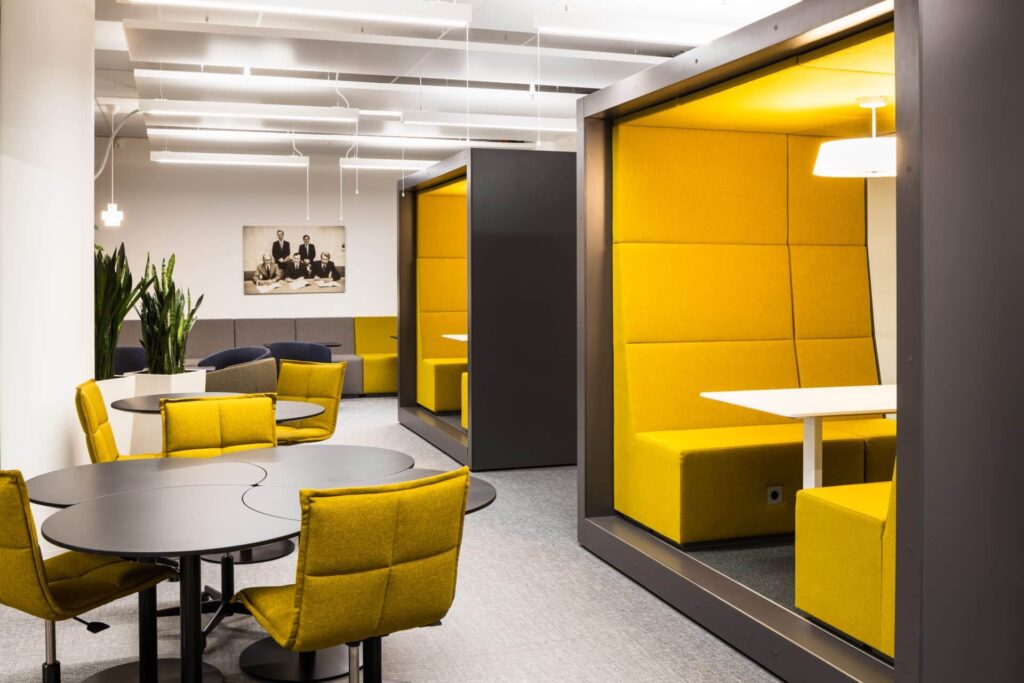
It is also possible to create a quiet concentration area in an open office space. Modern solutions such as modular partitions, soundproof office cubicles and acoustic panels offer effective alternatives. Properly designed quiet workspaces improve employee concentration and productivity in open-plan offices. Versatile and flexible solutions allow employees to change their workspace according to the requirements of their tasks.
Can a quiet workspace be built in an open space?
Modern techniques and solutions can be used to transform an open office into a semi-quiet working space. Soundproofed concentration areas can be created without heavy fixed structures or moving walls. Modular and movable solutions allow flexibility to adapt the space to the changing needs of the organisation.
Work environments have evolved from room offices to multi-room offices that make use of different working zones. The main challenge of the open office - noise and interruptions - is solved by creating clear areas for concentrated work. Soundproofed POD rooms, telephone boxes and farmshares allow you to work calmly even in a busy working environment.
What materials should be used to build a quiet workspace?
In a quiet workspace, the choice of materials has a significant impact on sound attenuation. Effective materials include porous acoustic panels, which absorb sound rather than reflecting it back into the room. These can be wall-mounted panels, ceiling-mounted elements or stand-alone room dividers.
High-quality acoustic panels are typically made of porous materials, such as:
- Fibres made from recycled PET plastic bottles
- Made of acoustic foam
- Wood fibres and cellulose
Sustainable material choices are increasingly important. Ecological acoustic panels are often made from recycled materials, which has a lower carbon footprint. Soundproofed rooms the construction also uses sound-absorbing wall elements, glass and plexiglass materials and double structures to prevent sound propagation.
How can you improve the acoustics of an open office without a complete renovation?
The acoustics of an open office can be significantly improved without major renovation. Portable partitions are an effective solution as they require no fixed installation and can be easily rearranged as needs change. Acoustic panels on the ceiling and walls reduce echo and noise dispersion in the room.
To improve sound insulation in an open office you can take advantage of:
- Transportable acoustic partitions and screens
- Ceiling mounted acoustic elements
- Self-contained, modular workstations (PODs)
- Phone heads for quick calls and video conferencing
These solutions are cost-effective alternatives that significantly improve the acoustics of the working environment. For example, strategically placed PODs allow employees to retreat to do concentration-intensive work or make phone calls without disturbing others.
How much does it cost to build a quiet workspace?
The cost of a quiet workspace varies considerably depending on the solution chosen. A lighter investment may be a single phone booth or a two-person POD room, while a larger solution may include several retreats of different sizes to meet different needs.
Cost breakdown for the most common solutions:
- Single phone booth: €3 000 - €7 000
- POD room for 2-4 people: 8 000 - 15 000 euros
- Acoustic room dividers: €500 - €1 500 each
- Wall-mounted acoustic panels: 100 - 300 euros/m²
Although building a quiet workspace requires an investment, the benefits will be felt in the long term. Productivity improvements, improved well-being at work and reduced sick leave make the investment worthwhile. In arithmetic terms, the productivity gains of just a few percent per worker will quickly cover the costs.
How does a quiet workspace affect worker productivity?
Research shows that quiet workspaces significantly improve worker productivity. Performance in tasks requiring concentration can improve by up to 25 % when distractions are reduced. Continuous interruptions in an open office can consume up to 86 minutes of a working day, equivalent to more than two working weeks a year.
Quiet working spaces have a positive effect:
- Concentration and deep work
- Reducing stress levels
- Working memory operation
- Creative problem-solving skills
- Job satisfaction and well-being
Many companies have found that allowing employees to choose the right workspace for their tasks increases job satisfaction. For example, at Valmet's premises in Espoo, employees can choose a POD workroom for tasks requiring concentration, while more open spaces are available for work requiring collaboration.
What is an effective quiet workspace design in an open office?
The efficient, quiet workspace in the open office has been carefully designed to serve its purpose. The optimal solution takes into account both acoustic properties and ergonomics to ensure a comfortable and efficient working environment.
Features of an efficient quiet workspace:
- Adequate sound insulation (at least 30-35 dB attenuation)
- Ergonomic furniture that supports a good working posture
- Suitable for all uses (1-4 persons)
- Good ventilation and appropriate temperature
- Appropriate lighting
- The necessary electrical and telecommunications connections
Modular POD rooms are often the ideal solution, as they can be installed without modification to fixed structures. They should be positioned with the movement of workers in mind, so that they are easily accessible but do not cause congestion on access routes.
The future of silent workspaces - where are we heading?
Quiet workspaces will continue to evolve to become more versatile and flexible. In the future, we will see ever smarter solutions where technology is seamlessly integrated into the workspace. For example, charging systems, automatic ventilation and lighting, and wireless charging are already part of modern PODs.
Future trends:
- More modular and adaptable solutions
- More ecological materials and sustainable manufacturing methods
- Intelligent systems that optimise the use of space
- Supporting hybrid work and better integration of teleworkers
- Biophilic elements that support well-being
When designing working environments, it is increasingly important to understand the requirements of different work tasks. INTO POD rooms and other retreats respond to this need by providing acoustic and visual protection for work requiring concentration. Solutions that support both concentration and collaboration are key elements of future work environments.
Take a look at a our references and be inspired by the projects that have been implemented - contact us, and together we will find the solution that suits you best!