





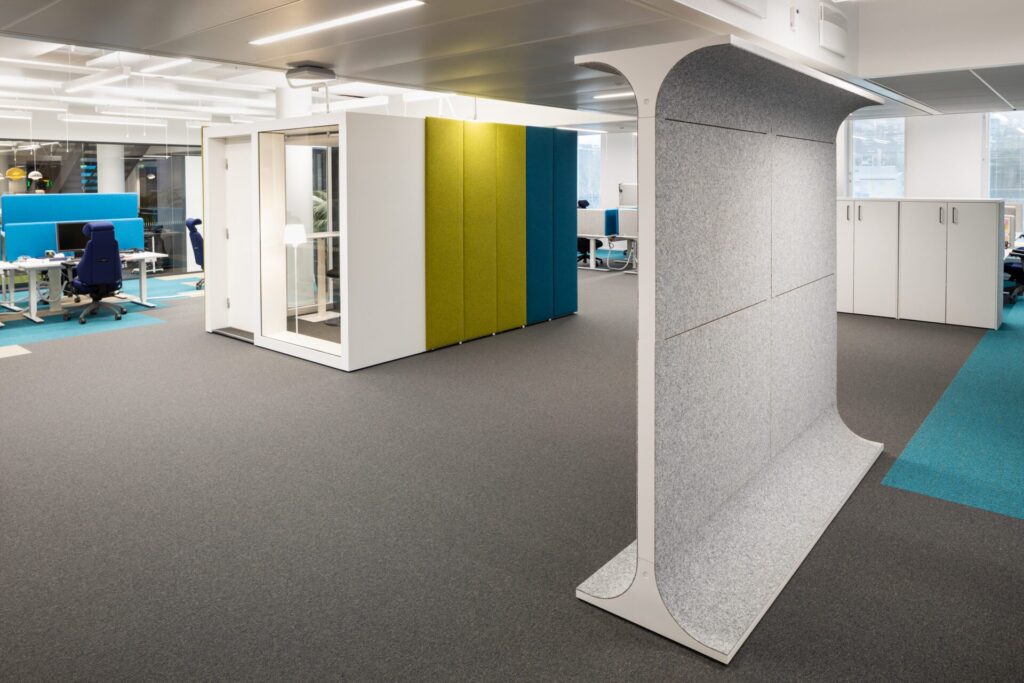
The adaptability and versatility of modern office spaces are key to finding solutions to improve privacy without major structural changes. A variety of partitioning options offer a flexible and cost-effective way to create private workspaces, improve acoustics and structure space according to business needs. Removable partitions, acoustic panels and functional furniture solutions allow you to transform your working environment without time-consuming and costly renovations.
Can partitions improve privacy without renovation?
Open plan workspaces are efficient in terms of space, but present challenges in terms of privacy and peace of mind. Space dividers offer an excellent way to create private areas in open environments without fixed structures. This makes office space more adaptable to changing needs.
Space sharing a major advantage is their flexibility. Unlike fixed walls, partitions can be easily moved, rearranged or removed as needs change. This allows you to quickly adapt your working environment for different uses, such as teamwork, individual concentration or informal meetings.
From movable wall units to sound-absorbing panels and multi-purpose furniture solutions, the range of room dividers is extensive. All these options offer an efficient way to improve privacy without the need to demolish or build new walls.
Cost-efficiency is a major advantage when choosing space dividers. Compared to a full renovation, room dividers are a much more cost-effective option. They do not require structural modifications, permit applications or extensive installation work, which reduces costs and speeds up implementation.
What are the most efficient space-sharing solutions for the office?
In office environments, the choice of partitioning depends on the size of the space, its intended use and acoustic requirements. There are many different options on the market, each with its own strengths and suitability for different situations.
Acoustic partitions are popular in open spaces where sound control is important. These specially designed panels absorb sound, reduce echo and improve speech clarity. They are particularly useful in rooms where phone calls are made or small meetings are held. Efficient acoustic partitions can significantly reduce background noise and create quieter workplaces.
Mobile serms offer maximum flexibility. They can be rearranged daily to meet changing needs. Available in different heights and degrees of transparency, they are suitable for different situations - low berms allow collaboration while maintaining a sense of personal space, while higher berms offer more privacy for tasks that require concentration.
Modular wall units are a more rigid solution, creating an almost room-like space in an open office. These units are typically taller and sturdier than standard studs, while providing sound insulation and visual screening. They are ideal for meeting areas or quiet work areas.
POD rooms represent a holistic solution to privacy needs. These ready-to-use, modular spaces can be placed in any open-plan room, creating a completely private space for meetings, calls or work requiring concentration. POD rooms have the advantage of complete soundproofing and the possibility of incorporating all the necessary technology and furnishings.
How do room dividers affect office acoustics?
Office acoustics are a key factor in well-being and productivity. Partitions not only improve visual privacy, but also have a significant impact on the soundscape of a space.
Sound-absorbing materials are one of the most important features of partitions in terms of acoustics. High-quality partitions use porous materials that absorb sound effectively at different frequencies. This reduces sound reflection and echo, which in turn reduces the overall noise level in the room.
Sound insulation is another important factor. Unlike sound absorption alone, sound insulation prevents sound from passing through the partition. This is particularly important when creating private areas in an open space. Thicker, multi-layered partitions typically provide better sound insulation.
Improving speech intelligibility is a key objective in acoustic design. Speech Transmission Index (STI) is a value that describes the intelligibility of speech in a room. A lower STI value outside room dividers means that private conversations remain private, which is very important when dealing with confidential matters.
Increased peace of mind is a major benefit of the space-sharing scheme. They create acoustic zones where workers can concentrate on their tasks without constant interruptions. Well-designed acoustic solutions reduce cognitive load, leading to better concentration and more efficient working.
How can POD rooms complement space-sharing solutions?
In modern office design, POD rooms have become a valuable element that complements partitioning solutions, creating a versatile and functional working environment. These compact, prefabricated spaces offer complete privacy when you need it most.
PODs work in synergy with other space dividers. While more open partitions create visual order and basic privacy, POD rooms provide perfectly soundproofed spaces for more intensive work situations. This combination allows different levels of privacy needs to be met in the same office space.
Work that requires concentration particularly benefits from POD rooms. Complex problem-solving tasks, creative work and projects that require precision often require a distraction-free environment. POD rooms create such a space even in the middle of open spaces, allowing short periods of intensive work without interruptions.
Video conferencing is commonplace in today's workplace, and POD rooms provide the ideal space for it. They prevent background noise from disturbing the conversation and provide a professional backdrop without the hustle and bustle of an office. They also ensure that private conversations do not disturb other employees.
For small group work, POD rooms provide an intimate and focused environment. They typically accommodate 2-6 people, making them perfect for small team meetings, brainstorming sessions or mentoring meetings. They can be easily booked on an as-needed basis, increasing the flexibility of the office space.
What to consider when choosing partitions and furniture?
The choice of partitions and the furniture that goes with them is a strategic decision that has a significant impact on the functionality of the working environment. Careful planning ensures that the solutions chosen will serve the needs of the organisation well into the future.
The choice of materials affects both the functionality and aesthetics of the partitions. The use of high quality acoustic materials improves sound absorption, while durable frames ensure longevity. Materials should also be easy to clean and fire resistant. The visual appearance should take into account the brand image of the company and the overall look of the office.
Mobility is a key characteristic that determines the flexibility of space dividers. Rotating solutions allow for quick changes, while heavier elements provide stability.
Adaptability also applies to the possibility of combining space dividers. Modular systems allow the creation of spaces of different sizes and shapes using the same basic elements. A functional space-sharing system grows and changes with the needs of the organisation.
Ergonomics must be taken into account in the choice of both the partitions and the related furniture. Workstations, seating and desks should work seamlessly with the partitions to create ergonomic units. Adjustable desks, ergonomic seating and correctly positioned partitions work together to create a healthy working environment.
Aesthetics is not just a superficial issue, it also affects the well-being at work and the image of the company. A coherent style, from room dividers to desks and seating, creates a harmonious whole. Colours, shapes and materials can be chosen to support the identity of the company and the architecture of the office space.
Strategic use of space allocators in the development of the working environment
The strategic use of partitions and other furniture solutions is a key element in the design of a modern working environment. At their best, they form a whole that supports both individual work and collaboration in the same space.
From a privacy perspective, partitions create different degrees of privacy zones that support different work tasks. In the work environment, it is important to provide both areas for concentrated work and more open spaces for collaboration. Strategically placed partitions and PODs allow for smooth transitions between these spaces.
Acoustics is a quality factor in the working environment that directly affects well-being and productivity. Comprehensive acoustic design involves the strategic placement of partitions and other sound-absorbing elements. The aim is to create acoustic zones that support a range of activities - from quiet concentration areas to more lively collaborative spaces.
Flexibility is a basic requirement for a modern working environment. Space dividers allow you to quickly adapt a space to changing needs - for example, converting an open plan room into a meeting environment or dividing a large space into smaller project teams. This adaptability increases space utilisation and cost-effectiveness.
For well-being at work, it is important that employees have the opportunity to choose the most suitable working environment for their job. Partitions and related furniture solutions allow different types of workstations to be created in the same space. When employees can choose a quieter corner for concentrated work or a more open area for collaboration, job satisfaction and productivity are improved.
Optimising office space as a whole requires careful planning and coordination of the different elements. Space dividers, PODs, seating and desks work together to form a functional whole that supports the organisation's objectives and work culture.
Work environment solutions should be planned for the long term, taking into account the organisation's growth prospects and changing ways of working. Modular and flexible solutions allow for future changes without the need for major renovations.
Take a look at a our references and be inspired by the projects that have been implemented - contact us, and together we will find the solution that suits you best!