







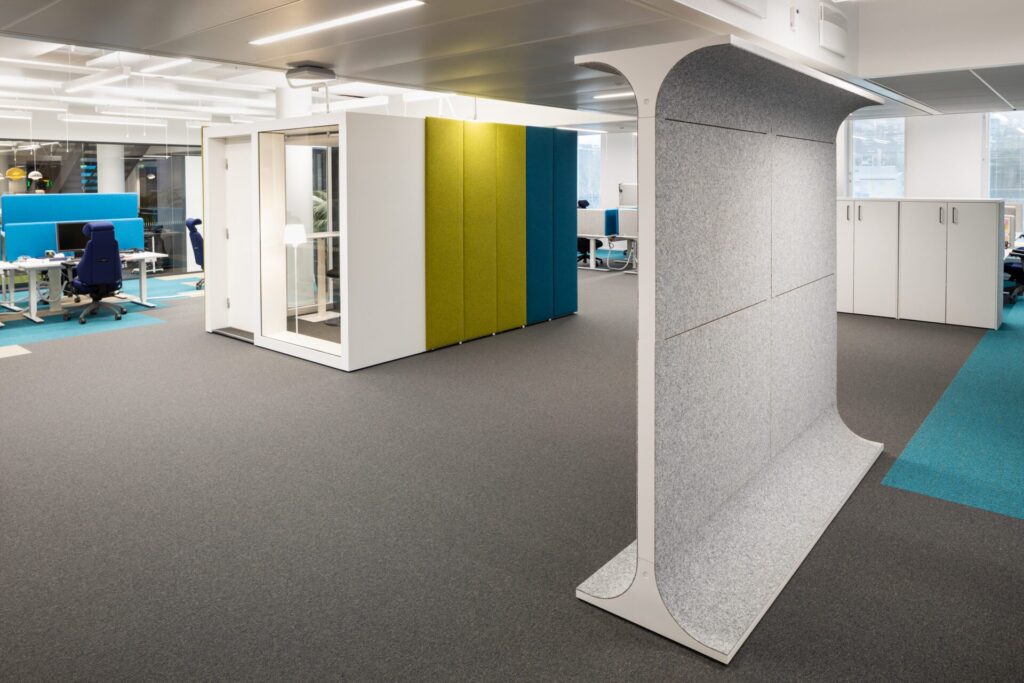
Modern room dividers reduce noise in office spaces by an average of 10-50%, depending on their structure, materials and placement. Acoustic room dividers are particularly effective, as they are designed to absorb and disperse sound waves. Studies show that the strategic placement of high-quality acoustic room dividers can significantly reduce noise levels and improve speech intelligibility in work environments. These solutions increase both sound insulation and visual privacy.
How much do room dividers reduce noise?
Efficient acoustic partitions can absorb and disperse sound waves, reducing noise levels by 10-50 per cent. The sound absorption capacity of the highest quality room dividers is equivalent to that of thin partition walls. In open-plan spaces, this means that the range of normal speech is significantly reduced.
When studying the behaviour of sound waves, it has been observed that well-designed room dividers prevent sound waves from travelling in a straight line and also absorb some of the sound energy. Acoustic measurements have shown that strategically placed room dividers can reduce speech intelligibility (STI value) at adjacent workstations to such an extent that it becomes significantly easier to concentrate on one's own work.
INTO the Nordic Silence products Acoustic measurements have shown that semi-open room dividers, for example, disperse sound up to six times more effectively than a completely open space. In practice, this means that employees sitting opposite each other with an acoustic room divider between them can hear each other's speech as clearly as if they were sitting 15 metres apart in an open space.
What factors affect the sound absorption capacity of room dividers?
The effectiveness of room dividers' sound insulation is influenced by several factors, one of the most significant being the material. Porous materials absorb sound more effectively than hard surfaces. Acoustic room dividers often contain special sound-absorbing materials, such as acoustic panels and foam plastics.
The thickness of the room divider directly affects its ability to absorb sound – a thicker structure provides better sound insulation. Height is also important: the higher the room divider, the more effectively it prevents sound from passing over it. The optimal height depends on the intended use of the space and the acoustic challenges.
Structural characteristics have a significant impact on sound absorption. Multi-layer structures containing both hard and soft materials are most effective at absorbing different frequencies. The shape of the room divider can also help to disperse sound waves, reducing reverberation in the room.
Ecological and sustainable materials are becoming increasingly important. Many acoustic solutions utilise recycled materials that are both environmentally friendly and effective at sound absorption. Environmentally conscious workplace solutions can be implemented without compromising on quality.
In which situations are room dividers the most effective solution for reducing noise?
Open-plan offices are a classic example of an environment where the benefits of room dividers are highlighted. In open workspaces, sound travels unimpeded, making it difficult to concentrate on demanding work. Strategically placed room dividers create acoustic zones that reduce the spread of distracting noise.
Meeting rooms and gathering areas benefit particularly from high room dividers, which prevent confidential discussions from being overheard elsewhere in the space. The placement of room dividers can also divide a large space into smaller functional areas while maintaining an open atmosphere.
POD rooms offer an excellent solution for situations where complete sound insulation is required. These modular spaces function as separate soundproofed areas within an open-plan office, enabling tasks that require concentration or private phone calls.
When designing the acoustics of workspaces, it is important to consider total use of space and the movement of people. The placement of room dividers can be used to guide traffic routes and create quieter work areas next to busier passageways.
What is the difference between standard room dividers and acoustic room dividers?
Standard room dividers are primarily designed to divide space visually, while acoustic room dividers also specialise in sound control. There are significant structural differences: standard room dividers are often thinner and made of simple materials, while acoustic versions utilise multi-layer structures for effective sound absorption.
There is a significant difference in sound attenuation capacity. A standard room divider can reduce noise slightly by preventing sound from travelling directly, but acoustic room dividers absorb and disperse sound waves much more effectively. This is also evident when looking at the technical specifications: acoustic solutions often have a sound absorption class and other acoustic values listed.
Acoustic room dividers often contain special materials, such as porous sound-absorbing layers, which reduce reverberation and improve speech clarity. Due to these special features, acoustic room dividers are usually more expensive, but their impact on the comfort and functionality of the working environment is also significantly greater.
INTO Concept acoustic room dividers combine stylish appearance with effective sound absorption, offering versatile solutions for different workplace needs.
How can room dividers be combined with other acoustic solutions?
Comprehensive acoustic design combines different elements to create an optimal working environment. Room dividers work effectively in conjunction with POD rooms – room dividers create acoustic zones in open spaces, while POD rooms provide complete sound insulation for situations that require it.
Seating furniture, especially high-backed sofas and armchairs, complements the effect of room dividers by creating small acoustic ”bubbles” for conversation and collaboration. This multi-layered approach optimises the acoustics of the space for different activities.
The positioning of workstations in relation to room dividers is essential. Properly designed workstations take advantage of the acoustic protection provided by room dividers, and together these elements create effective working areas. For example Focus workstations Combined with acoustic room dividers, they offer excellent protection both visually and acoustically.
The advantage of layered solutions is their ability to respond to different acoustic challenges simultaneously. Some elements absorb high frequencies, others low frequencies, and together they create a balanced and pleasant sound environment. Comprehensive acoustic design for workspaces takes into account both sound propagation and the acoustic requirements of different activities.
Acoustic solutions for the working environment – the key to better well-being at work
The acoustics of the working environment have a direct impact on well-being at work. Studies show that good acoustics reduce stress, improve concentration and increase job satisfaction. Constant exposure to noise, on the other hand, increases the production of stress hormones and can lead to burnout in the long term.
Acoustic solutions such as room dividers, POD rooms and acoustic workstations significantly improve employees' ability to concentrate. When distracting background noise is reduced, cognitive load is reduced and concentration on tasks improves. This is directly reflected in improved productivity and work quality.
Practical tips for improving acoustics in the workplace:
- Divide open spaces into acoustic zones using room dividers
- Place workstations that require concentration further away from busy walkways.
- Provide employees with POD rooms for phone calls and tasks that require concentration.
- Combine different acoustic solutions to achieve a comprehensive effect
- Consider acoustics already at the design stage of the working environment
Our team of experts at INTO Concept can help you identify acoustic challenges in your work environment and recommend solutions. effective solutions. Acoustic design is a key part of modern workplace design, which takes into account both the visual appearance and functionality of the space.
Take a look at a our references and be inspired by the projects that have been implemented - contact us, and together we will find the solution that suits you best!