







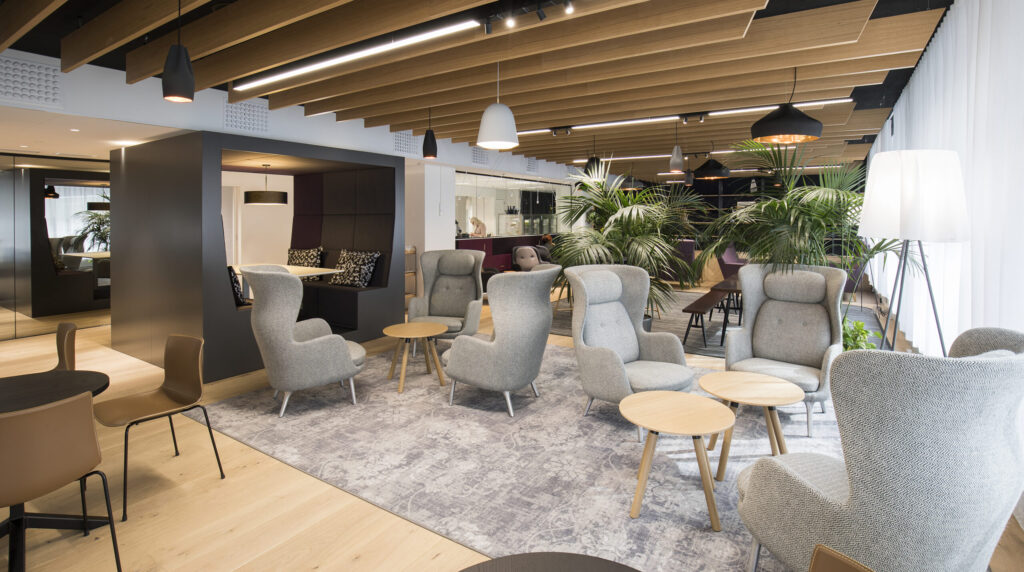
Office furnishings have a significant impact on acoustics, as the materials, shapes and placement of furniture either reflect or absorb sound. Hard surfaces such as glass and metal reflect sound, causing echoes, while soft and porous materials effectively dampen noise. Properly selected furniture solutions, such as soundproof booths, room dividers and acoustic panels improve the sound environment in the workplace and create better conditions for concentration.
What is the importance of acoustics in an office environment?
Acoustics determine how sound behaves in a space and directly affect employees' concentration, productivity and well-being. Poor acoustics cause disruption, stress and hinder communication, while a good sound environment supports efficient work and collaboration.
The most common acoustic challenge in open-plan offices is excessive background noise caused by colleagues talking, phone calls and other office sounds. When sounds bounce off hard surfaces, they create echoes and the noise level becomes distracting. This makes it particularly difficult to concentrate on demanding work and can even lead to burnout in the long term.
In enclosed spaces such as meeting rooms, acoustic challenges often relate to reverberation time and sound insulation. If a space has a lot of echo, it makes it harder to understand what people are saying and makes meetings more stressful. Not enough soundproofing can mess with privacy and bother people in nearby spaces.
How does furniture affect sound transmission in an office?
Furniture affects sound transmission in the office through its material, shape and placement. Hard surfaces such as glass, metal and polished wood reflect most of the sound waves back into the room, which increases reverberation and noise levels. Soft and porous materials, on the other hand, absorb sound effectively.
The amount of furniture in a room has a significant impact on acoustics. An empty or sparsely furnished room echoes strongly because sound waves are reflected unimpeded from the walls, floor and ceiling. When furniture is added to a room, it breaks up the direct paths of sound waves and reduces echoes.
The placement of furniture determines how sound travels within a space. Strategically placed furniture can direct sound away from sensitive work areas or create acoustic zones that separate quiet work areas from collaborative spaces. Tall furniture acts as a sound barrier and prevents sound from spreading to a wider area.
Which furniture solutions improve office acoustics?
Furniture solutions that improve office acoustics can be divided into three main categories: soundproofed rooms, room dividers and acoustic surfaces. Each solution meets different acoustic needs and can be combined to achieve the best result.
Soundproof booths and office booths offer the most effective solution to noise problems. These enclosed spaces are designed to effectively dampen sound both from the inside out and from the outside in. They are ideal for phone calls, video conferences and work that requires concentration. An acoustic workstation in a cubicle allows you to work undisturbed in the middle of a busy office.
Room dividers and acoustic panels act as sound barriers in open-plan spaces. They do not completely isolate sound, but they significantly reduce sound propagation between workstations. Room dividers made of porous materials absorb sound and reduce echoes while providing visual protection.
Acoustic furnishings, such as upholstered seats and padded wall elements, act as sound-absorbing surfaces. They absorb the energy of sound waves and reduce reverberation time, making the space more acoustically pleasant. STORY WALL solutions combine space division and acoustic absorption into a functional whole.
How to design office furniture with acoustics in mind?
Acoustics should be taken into account right from the early stages of furniture design by planning different zones. The office should be divided into different acoustic zones: quiet areas for concentration, moderately noisy areas for collaboration, and more active social areas. This helps to direct noise-generating activities away from areas that require quiet.
Material choices play a key role in acoustic design. A balance between hard and soft surfaces is needed: too many hard surfaces cause echoes, but visual appearance and practicality must also be taken into account. Porous materials such as acoustic fabrics and padded surfaces should be strategically placed where sound is generated or where it causes the most disturbance.
The principles of furniture placement have a significant impact on the final result. Tall furniture and soundproofed rooms It is worth investing in creating acoustic barriers between different functions. Workstations should be positioned so that employees do not sit face to face, which reduces the amount of distracting conversation. A balance must be found between open and closed spaces: spaces that are too open echo and cause distraction, but spaces that are too closed can feel oppressive.
Acoustic design is not a one-off measure but a process that requires evaluation and possible changes during use. Feedback from employees about the sound environment is valuable information that can be used to supplement the furnishings with acoustic solutions if necessary.