







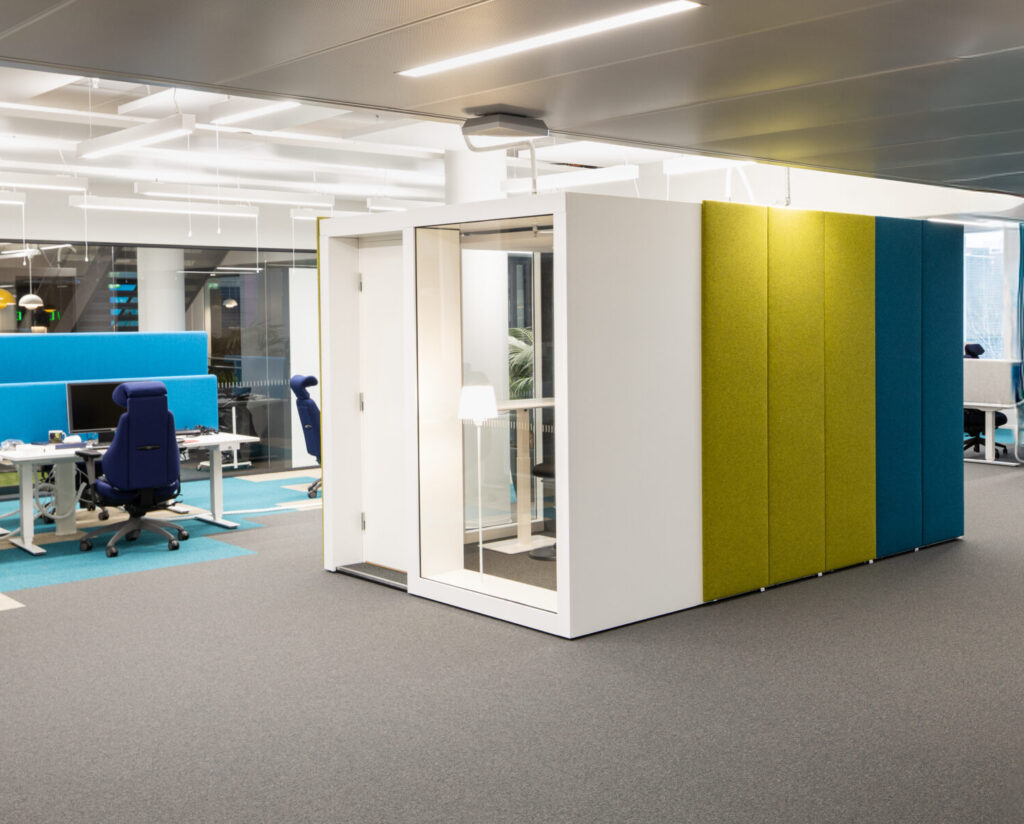
Phone booths improve working conditions by providing employees with a quiet and private space to concentrate on tasks and calls in an open office environment. They reduce distractions, improve working peace and allow confidential matters to be handled without interruption. Phone booths address the key challenges of open offices and support both wellbeing and productivity in modern, multi-tenant offices.
What is a phone box and what is it used for?
The phone booth is modular private space, designed to provide a quiet environment for calls and concentration-demanding tasks in open offices. It is typically a one-person space that can be installed in existing premises without structural modifications. Phone booths are used for private calls, video conferencing and other work tasks that require a distraction-free working environment.
In modern working environments, phone booths are a key part of the multi-office concept. They complement open office collaboration areas by providing retreats where employees can carry out a variety of tasks in an appropriate environment. In flexible workspaces, telephone booths mean that a meeting room for eight people does not need to be used for individual calls, which significantly improves space efficiency.
The uses of phone booths vary according to the needs of the organisation. They are ideal for customer calls, remote meetings via various online platforms, non-verbal work, and situations where visual protection and privacy are required. As digital working becomes more and more common, the importance of telephone booths will grow.
How do phone booths solve the challenges of an open office?
Phone booths offer a concrete solution address the typical problems of open offices by creating physically isolated spaces that reduce sound transmission and provide visual privacy. They allow employees to work in a place where they are not disturbed by noise and other distractions. A phone booth creates a safe space where private conversations can take place without fear of others overhearing confidential matters.
The main challenge for open offices is to carry out different tasks in the same space. While some employees work in teams and actively discuss, others may need complete silence for tasks that require concentration. This conflict leads to a loss of concentration and work efficiency. Phone booths solve this problem by providing a range of support spaces where everyone can choose the most suitable environment for their task.
A sense of privacy and security have a significant impact on an employee's ability to concentrate. When someone can read an email you've written behind your back or hear your private phone call, it's easy to lose concentration. Phone booths provide both visual and acoustic protection, improving peace of mind and allowing you to work more efficiently without constant interruptions.
What are the main benefits of phone booths for employees?
The main benefits of phone booths for employees are improved concentration, resulting from a distraction-free working environment. When workers can retreat to their own space for demanding tasks, work quality improves and tasks are completed more efficiently. Phone booths reduce the stress caused by constant exposure to noise levels and distractions in an open office.
Privacy is another important advantage. Confidential matters can be handled securely in a phone booth without the worry of colleagues or clients overhearing sensitive conversations. This is particularly important in customer service work, personnel matters and any situation where confidential company or customer information is handled.
Phone booths support well-being at work by giving employees control over their own working environment. Being able to choose when to work in an open space and when to work in privacy increases the sense of autonomy. This has a positive impact on job satisfaction and motivation. Working undisturbed in a telephone booth also allows for deeper concentration, which improves both the quality of work and the employee's experience of his or her own performance.
In the age of digital working, telephone booths provide a suitable environment for video conferencing and remote meetings. Employees can participate in online meetings without disturbing others and without background noise that would undermine the professional impression they give to clients or partners.
How to choose the right phone booth for your workspace?
Choosing the right phone booth starts an assessment of the needs of the space and the number of users. Think about how many employees regularly need private space for phone calls or tasks that require concentration. If the office has a large number of people making calls to clients or participating in remote meetings, more phone booths may be needed to avoid congestion.
The size and layout of the room have a significant impact on the functionality of the phone booth. Make sure that the model you choose fits into the space available and is easily accessible to employees. Modular solutions, which can be installed without modification to existing structures and dismantled and reassembled if necessary, offer flexibility for future changes.
Ergonomics and comfort are key factors for long-term use. A telephone booth should have enough space to work comfortably, a good seat to support the correct working posture and suitable desk space for using a computer or note-taking equipment. Ventilation is an essential feature to ensure fresh air even during prolonged work.
Lighting affects both the comfort and efficiency of your work. Choose a telephone booth with adequate and adjustable lighting for different types of work. Integration into the existing office environment is also important - the phone booth should fit in stylistically with the rest of the interior and support the overall look and functionality of the office.