




Can you tell us briefly about yourself and your background in design?
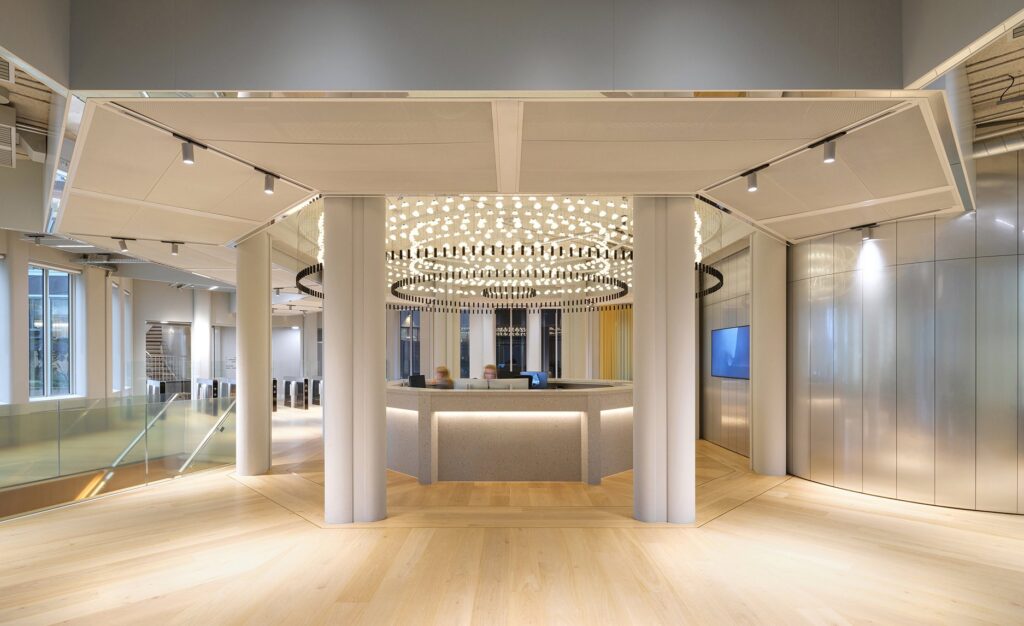
My name is Christiaan Fokkema and I am an architect and a partner at Hollandse Nieuwe We specialise in interior design, but we always say that we do everything except new build. That means we are not only interior designers, but we also do large renovations, refurbishments, and everything in between.
My role in the office is to be responsible for the creative output. I am involved in every project and help set the overall direction for the office. At the moment, around 17 people work in our office.

Christiaan Fokkema, architect and partner in Hollandse Nieuwe design office
What kind of projects are typical in your country, and what kind of projects do you design?
In the Netherlands, the building sector is increasingly shaped by sustainability, circularity, and innovative housing development, responding to a pressing need for efficient and resilient urban environments. As an office, we strongly focus on sustainable and circular projects in interior architecture.
A strong trend in the Netherlands is circular design and circularity. The country is leading in this field, at least in Europe. As an interior design office, we are trying to specialise in circular interiors, for example, designing spaces that are built from 80 percent reused or demolition materials. This is something we are actively innovating in, and it reflects a growing interest among clients.
Most of our projects are offices, which make up about 70 percent of our work. The remaining 30 percent consists of educational buildings and public buildings, such as government and municipality projects.
How have work and learning environments developed over the past 10 years?
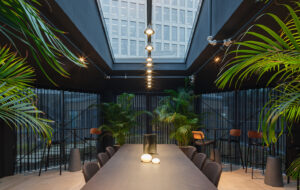
Before 2020, most office and learning environments were moving toward activity-based working. Many companies had already renovated their offices once or twice to adapt to this way of working. However, there was not much real innovation at that time. Everyone talked about flexibility, but nobody really knew what flexibility actually meant.
Then came COVID. During 2021 and 2022, many employers focused on getting people back to the office. They thought that creating a kind of clubhouse with bars and well-being facilities would bring young people back. That turned out not to be true. People still prefer to work from home one or two days a week.
In the Netherlands, commuting times are short, so the situation is a bit different compared to other countries. Even so, office occupancy is very low. Large clients often have an average occupancy of only 30 to 40 percent during the week, with Tuesdays and Thursdays being the busiest days. Occupancy has slightly increased over the last year or two, but not significantly.
How has this affected the way offices are designed today?
Clients sometimes come to us because they do not know what to do with low occupancy. On paper, they could reduce their space by half, but they are unsure if that is the right decision. We deal with many projects that focus on reducing space while increasing quality.
This means fewer desks and more meeting spaces, especially creative and collaborative spaces. There is also a strong focus on acoustics and on designing for neurodiversity. Some people work well with background noise, while others need silence, for example. Designing for diversity and inclusion has become an important trend in recent years.
How important are sustainability and environmental responsibility in your work?
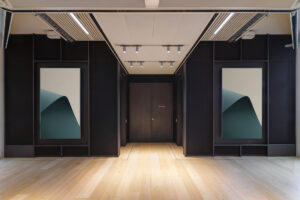
Sustainability is very important to us as a company. We have had a strong internal interest and a sense of responsibility for more than ten years. One example is the Greenpeace office we worked on in the Netherlands, which was fully circular and made from reused materials.
From the client side, it depends. Corporate clients usually have high sustainability standards, but these are often very generic and focused on labels such as energy and water consumption. Many clients do not fully understand how sustainability works in practice. We try to educate them by showing the impact of material choices, such as how much CO₂ is embedded in different materials. Usually, clients are willing to make better choices once they understand the impact.
The government plays a very important role in the Netherlands. They are required to upgrade their real estate portfolio to Energy Label B, which has led to large-scale renovations. The government sets high standards and actively enforces them, which pushes the market and drives innovation.
What is the most meaningful project you have worked on?
The most meaningful project for me is a current government project that has been designed but not yet delivered. It is the largest project I have worked on, about 55,000 square metres. It is also a very circular project. We designed the building almost entirely using materials found on site or sourced from donor projects. This forced us to think differently and come up with radical ideas. Instead of deciding what we wanted and then sourcing materials, we worked the other way around: we looked at what we had and designed from that. It was challenging but also very rewarding to create something beautiful using existing materials.
How do you see work and learning environments developing in the future?
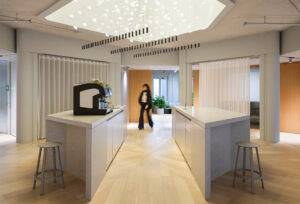
I think we will build fewer new buildings in the future. People will continue to work in hybrid ways, choosing what works best for them personally. Existing buildings will become more important, and fewer buildings will be demolished, even older buildings from the 1950s and 1960s. Appreciation for existing buildings will increase.
As a result, the quality of buildings will rise. Interiors will be better in terms of sustainability, energy performance, and aesthetics. Diversity and inclusion will remain important themes, especially in Western Europe.
I do not believe strongly in the full digitalisation of space, such as virtual reality offices. Physical space will remain very important. In education, we are currently in a transition phase. Schools are experimenting with different learning models and approaches to technology, and it will take time before things settle and learning environments adapt fully.
What role do AI and technology play in the future of design?
I have been following AI development closely for the past two years, and I am quite disappointed so far. There was a lot of optimism, but I do not see many strong use cases or world-changing solutions yet. AI tools can make some tasks faster and easier, but the impact on real innovation is limited – for now.
AI might help generate ideas more quickly, but I am not convinced that it will improve quality. Some clients may accept AI-generated solutions, but that will push architects to focus even more on human quality and creativity. I do not believe AI will significantly change buildings in the near future. People do not change easily, and physical, human spaces will continue to matter.