







What is sound?
Briefly defined, sound is a vibration propagating through a medium that causes an auditory perception. It is a mechanical wave motion that does not propagate in a vacuum, but always needs a medium. The medium can be in any form, such as a gas, liquid or solid. Sound propagating in air and liquids is a longitudinal wave motion. In solids, sound can also travel as a transverse wave motion.
Sound can be detected as a tactile sensation, an auditory sensation or by measurement.
The human auditory range is at its best between 16 and 20 000 Hz. Sounds below this limit are called infrasound, and those above are called ultrasound.
The human ear is most sensitive in the 20 Hz to 20 kHz frequency range, which is where many warning and alarm sounds, for example, occur. This frequency range, which is the most optimal for human hearing, is called the precession range. Emphasising the pre-sensor band and removing distractions improves speech clarity and the hearing of desired sounds.
Room acoustics
Sound insulation refers to the ability of structures to prevent the transfer of sound from one space to another or to prevent sound from passing through a structure.
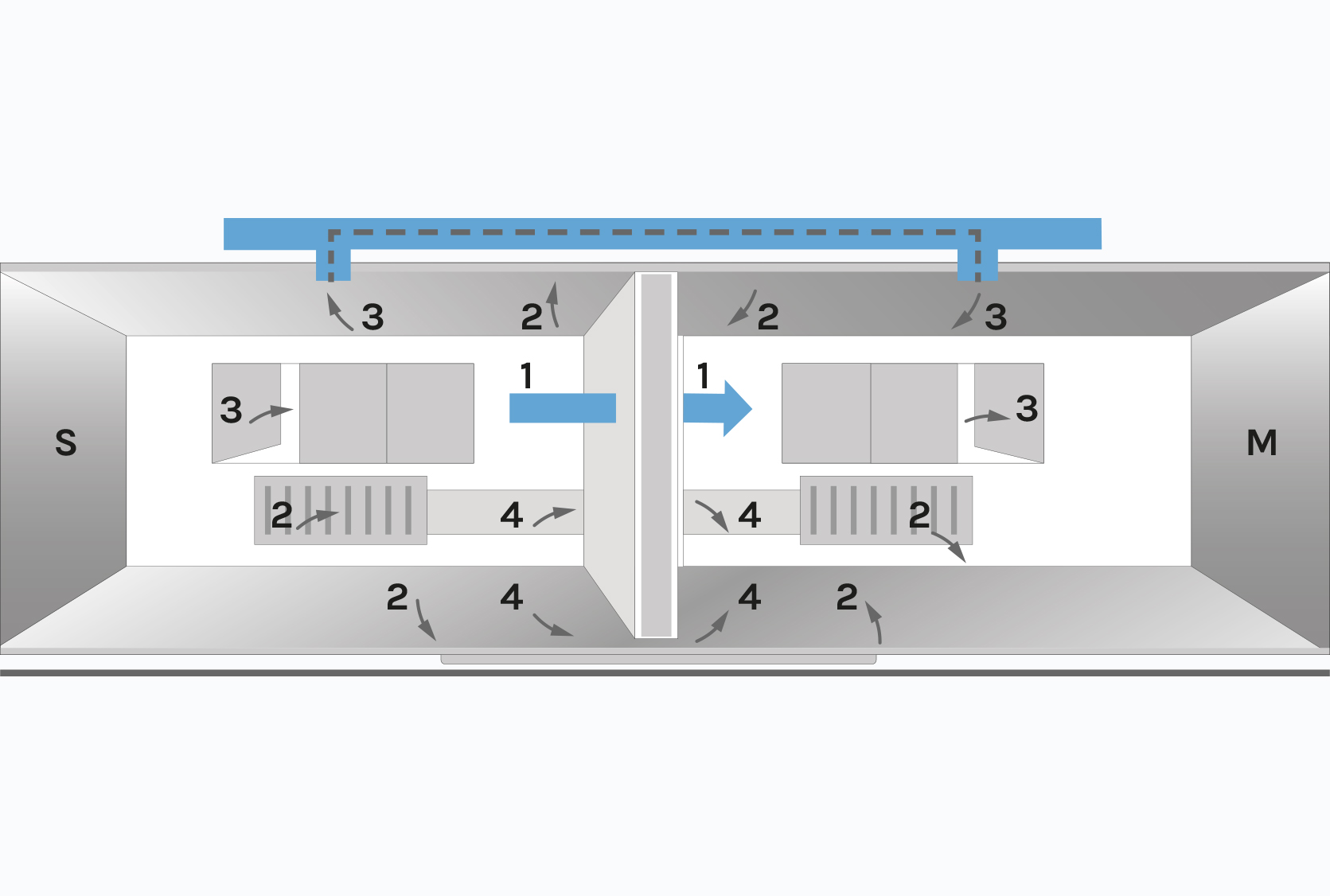
There are often a few problems with room acoustics, here are the most common ones:
- Sound travels from room to room directly through the wall
- Sound conducting ceiling and floor elements in the room
- The ventilation ducts and windows of the room allow direct transmission of sound
- Seams in walls and floors allow sound to leak from one room to another
Functional and practical space planning helps solve room acoustics problems: how to position workstations, and what acoustic elements to use.
Sound attenuation/absorption
Attenuation of room surfaces refers to the ability of materials in a room to absorb sound energy and thus attenuate the sound level.
Absorbent surfaces include ceilings, walls, floors, upholstered furniture, curtains, etc. Sound waves are also absorbed by people in the room. The main surfaces that contribute to attenuation are the ceiling and the walls.
Carpets mainly affect the sound of footsteps.
Reverberation
Reverberation or echo describes the impression created by sound in a room. When there is a lot of reflected sound in a room, the room is echoing. Hard surfaces reflect sound and cause echo, while sound absorbing materials reduce it and make the room feel more comfortable. The shape of the room also affects echo.
Reverberation time is a unit of measurement of reverberation and the effectiveness of sound attenuation. The reverberation time is the time it takes for the sound pressure level to drop to 60 dB.
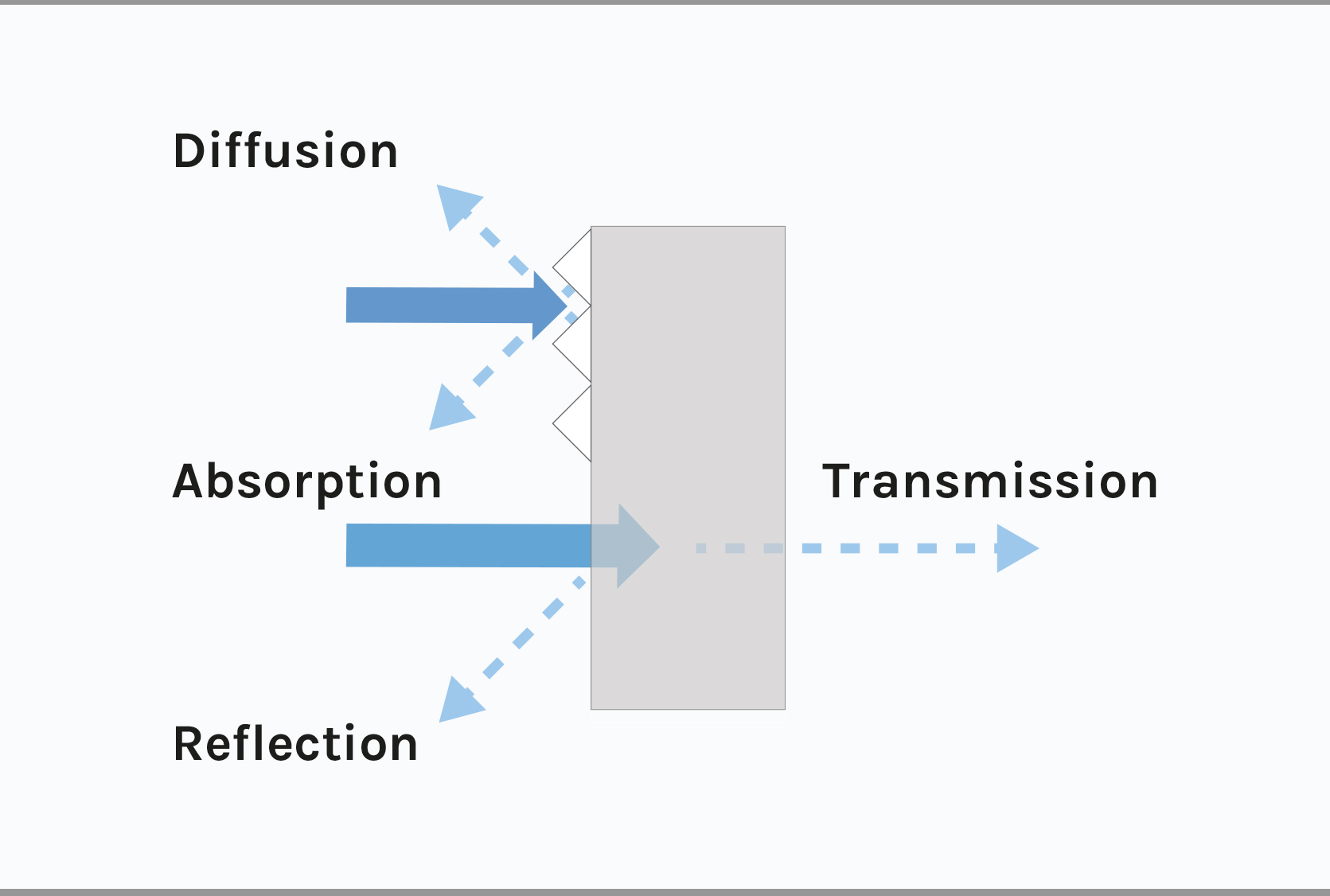
When sound waves hit the boundaries of a room (ceiling, floor, walls), some of the sound energy is absorbed by the material, some passes through the material, and some is reflected and scattered around the room as shown in the figure above.
Desibelit
Sound pressure is created when sound waves cause changes in air pressure in the air. The lowest audible sound pressure is called the threshold of hearing, and the highest audible sound pressure is called the threshold of pain.
Sound pressure is described using a logarithmic scale, expressed in decibels (dB). The lowest audible level is 0 dB and the highest level is about 120 dB.
Sound attenuation index Rw
The sound attenuation index is expressed in decibels (dB) and can only be calculated for a single material or component, not, for example, for an entire room. This is a laboratory measurement, using information on the relative size of the test rooms, the reverberation time in the receiving room, the known noise level and the size of the test piece to give the most accurate figure.
So, as a rough example, the sound attenuation index of a door could be measured by playing music through a loudspeaker in the room, and then measuring the sound pressure level (dB) coming through the door. As you correlate the information about the reverberation time, the sound pressure level of the music, and other variables, you get a fairly accurate picture of the sound attenuation index.
Sound attenuation index R'w
Sound attenuation index R'w is a field measurement that attempts to measure the sound attenuation index of a material in an actual, finished structure or space (e.g. walls between two office rooms). It cannot take into account the results of alternative sound transmission paths (e.g. sound leakage at joints) and therefore this live measurement method usually gives a lower result than the laboratory calculated value.
Speech transmission index STI
The speech intelligibility index is a measure of the intelligibility of the speech transmitted. It is generally applicable to measure the impact of different acoustic environments, transmission channels and interference.
The Speech Transfer Index (STI) is a method of measuring speech intelligibility. STI measures the characteristics of a room (acoustic equipment, acoustic panels, carpet, etc.) and indicates the ability of the channel to transmit sound.
When designing telephone booths and other quiet support spaces such as conference and meeting rooms, it is always worth looking at the speech transmission index of the space. This often tells you more about the sound environment of a space than individual sound attenuation values (decibels).
When measuring the speech transmission index of modular conference rooms and telephone booths, ”low” is the target value. A low value means that speech intelligibility outside the room is also low, meaning that private conversations and negotiations can be held without any concern that the person outside the room can understand what is being said.
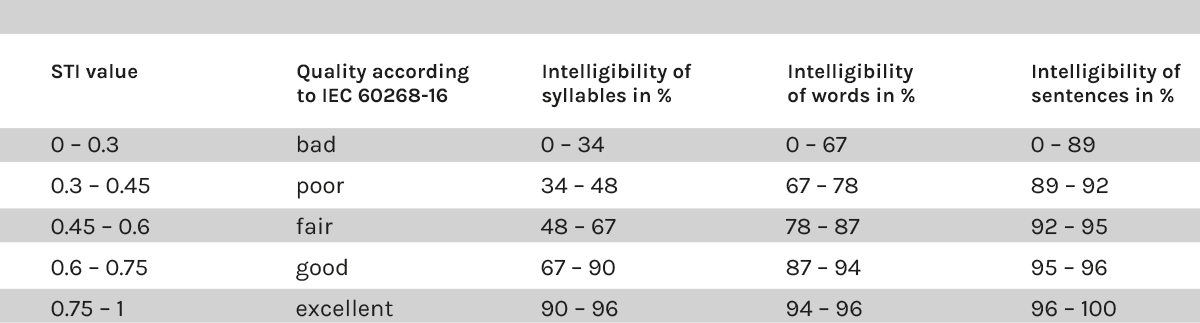
STI value = STI value
Quality according to IEC 60268-16 = Quality according to IEC 60268-16 standard scale
Intelligibility of syllables in % = Intelligibility of syllables %
Intelligibility of words in % = Intelligibility of words %
Intelligibility of sentences in % = Intelligibility of sentences %
Sources:
https://www.ecophon.com/fi/akustiikkaratkaisut/akustiikan_tietopankki/
https://www.kotiakustiikka.fi/huoneakustiikka.html
https://fi.wikipedia.org/wiki/%C3%84%C3%A4ni
http://www.cs.tut.fi/sgn/arg/akusem/akuintro.pdf
http://www2.siba.fi/akustiikka/index.php?id=8&la=fi
Kylliäinen, M. and Hongisto, V. (2007). Acoustic design of buildings. Helsinki: Finnish Association of Civil Engineers.
Kylliäinen, M. and Hongisto, V. (2011). Acoustic design of buildings: industrial premises. Helsinki: Finnish Association of Civil Engineers.