







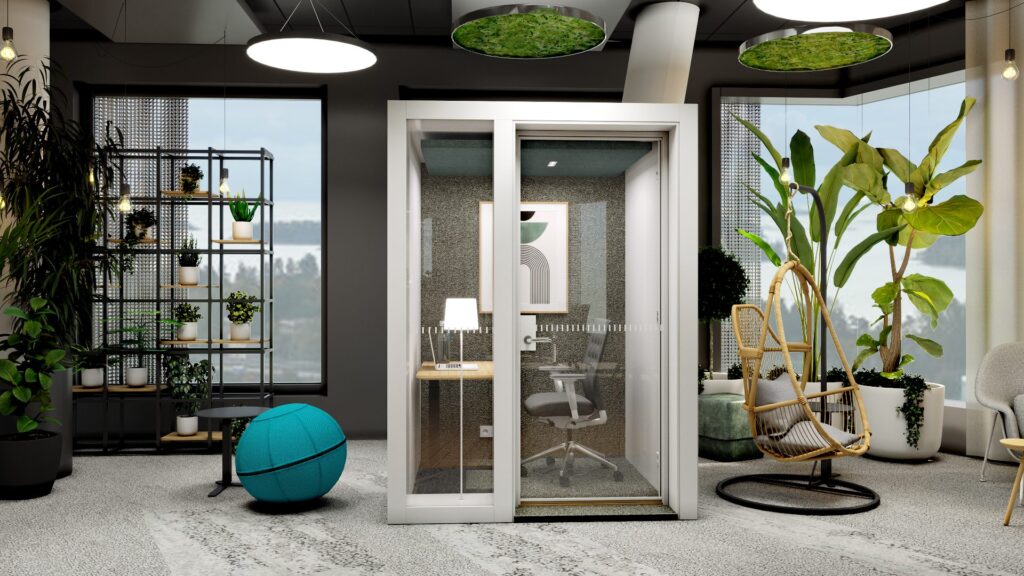
The optimal location for an office POD is based on several key factors: accessibility, visibility and intended use. The ideal location is easily accessible but sufficiently far away from major traffic routes to avoid disturbances. A strategically located POD serves its users efficiently, supports smooth workflows and ensures high utilisation rates. The best location takes into account sound insulation, ventilation and aesthetic compatibility with the overall look of the office space.
What is the best location for an office POD?
Office PODs Optimal placement requires careful planning. It is essential to consider the intended use of the POD – is it for individual work requiring concentration or possibly small-scale meetings? Employees' travel routes have a significant impact on the utilisation rate of the POD: a location that is too remote reduces usage, while a location that is too central may be prone to disturbances.
Lighting is also an essential factor – the POD should be positioned so that there is sufficient artificial lighting. Visual connections to the surroundings affect both ease of use and the sense of privacy. In the right place employee satisfaction and POD utilisation can be significantly improved.
For example, at FIM Private Bank, POD rooms were strategically placed close to workstations and corridors, making them easy to access when needed. This solution has improved the functionality of the space and increased the utilisation rate of the PODs.
How does the placement of an office POD affect employee productivity?
The location of the POD has a direct impact on employees' concentration and productivity. A well-placed office POD provides a quiet space for tasks that require concentration and enables undisturbed working in an open-plan office environment. When the POD is easily accessible from workstations, employees can use it more effectively for impromptu phone calls or virtual meetings.
Studies show that employees who have access to quiet retreats find their work more efficient and meaningful. Optimal placement An open-plan office can reduce interruptions by up to 30% and significantly improve employee satisfaction.
It is particularly important to take into account the varying needs of work – sometimes privacy and peace are needed, sometimes cooperation and communication. In the renovation of Orion's head office, PODs were placed close to workstations, allowing employees to easily switch to tasks that require concentration without spending significant time moving between rooms.
What factors should be considered when choosing a location for an office POD?
When choosing a location for an office POD, several factors must be taken into account that affect both the user experience and the utilisation rate of the POD:
- Acoustics – The POD should be positioned so that its sound insulation works as effectively as possible. The insulation structure of INTO POD rooms provides excellent acoustic protection from disturbing noises.
- Ventilation – POD requires adequate ventilation to function as a pleasant working environment, which affects its placement.
- Lighting – Adequate lighting is essential for efficient work.
- Electrical connections – When positioning the POD, consider the availability of electricity and network connection options.
- Privacy screen – Adequate privacy is important in many work tasks, which affects the orientation of POD's glass surfaces.
- Access routes – The POD should be placed so that it is accessible but does not obstruct passageways.
- Accessibility – All employees should have easy access to POD.
Different solutions are suitable for offices of different sizes. In smaller offices, PODs can serve as room dividers, while in larger spaces they can be grouped into separate zones. INTO POD rooms are modular in size, which makes it easy to arrange them in relation to each other without awkward gaps that are difficult to clean.
How should an office POD be positioned in relation to other workspaces?
The strategic placement of office PODs in relation to other workspaces plays a key role in creating a functional working environment. PODs should be placed at a suitable distance from open-plan spaces – close enough to be easily accessible, but far enough away to minimise distractions.
Located close to the meeting rooms, PODs offer a flexible option for smaller meetings, freeing up larger meeting rooms for other uses. Regarding break rooms PODs should be placed further away so that the sounds do not carry and disturb concentration.
At the UTU office, the POD MAX meeting room was strategically placed so that it can flexibly serve both smaller and larger meetings. At the Green Party office, the POD 2 room was positioned to provide a quiet retreat for online meetings and work requiring concentration, which has significantly improved the functionality of the working environment.
How can the location of an office POD support a company's communications and brand image?
The strategic placement of office PODs can serve as an effective means of communicating your company's values and work culture. Stylish PODs placed in prominent locations convey a modern, employee-friendly work culture to both visitors and potential employees.
PODs can be integrated into a company's visual identity by selecting colours and materials that match the brand. Successful placement provides an impressive first impression for visitors and reflects the company's values, such as innovation, flexibility and appreciation of well-being at work.
The Greens chose the INTO POD room for their office in Helsinki, and POD's innovative and stylish design and acoustic properties reinforce their brand image. The POD room highlights the organisation's values and commitment to a high-quality working environment.
Future trends in office POD placement
The transformation of working life and the increasing popularity of hybrid work are having a significant impact on how office PODs will be located in the future. Offices will increasingly be used specifically for collaboration and meetings, which emphasises the role of PODs as flexible spaces for both teamwork and individual work.
Technological advances are making PODs increasingly intelligent – in the future, we may see PODs that automatically indicate their occupancy status or adjust lighting and ventilation according to user preferences. Modularity and adaptability will become increasingly important, as work environments must be able to adapt quickly to changing needs.
INTO POD rooms already meet these future needs – they can be assembled and disassembled up to ten times, allowing for flexible modification of workspaces as the organisation develops. The modular structure provides the agility required in future work environments.
In the future, the placement of PODs will increasingly focus on comprehensive work environment experiences, with PODs forming a key element in the office's versatile space palette.
Take a look at a our references and be inspired by the projects that have been implemented - contact us, and together we will find the solution that suits you best!