







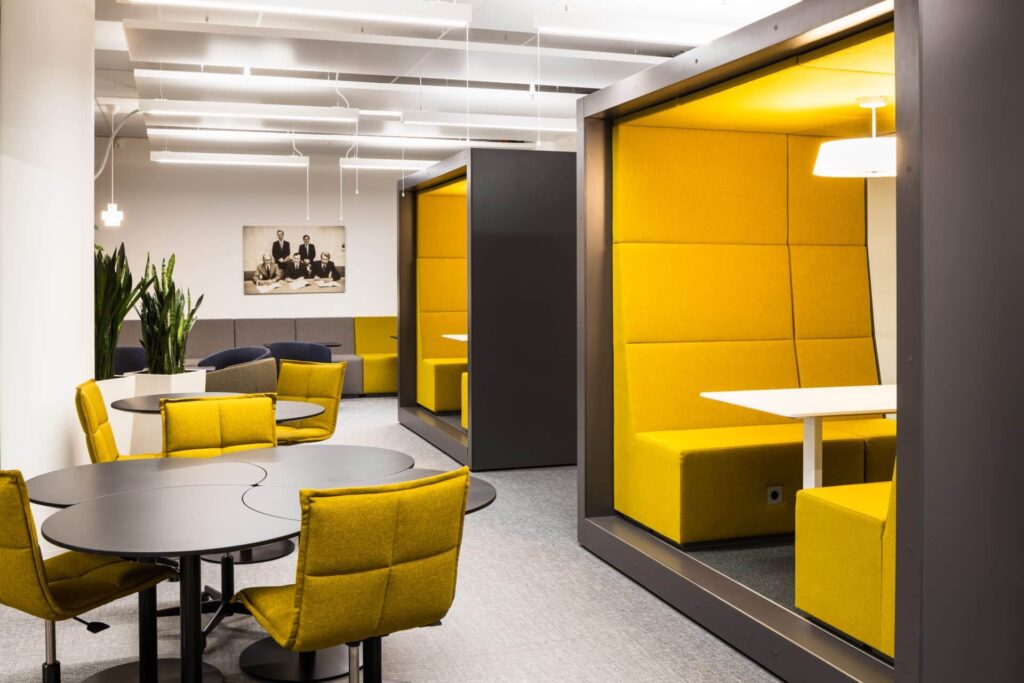
Providing a quiet workspace in the office requires comprehensive planning that takes into account both acoustics and ergonomics. A functional quiet workspace is created by combining appropriate partitions, ergonomic furniture and sound-absorbing elements. The most effective solutions are based on the real needs of the workforce - it is important to provide different spaces for different work tasks, such as soundproofed offices for more focused tasks and more open areas for collaboration.
What is the best way to organise a quiet workspace?
In the modern work environment, spaces that support concentration have become key. With the proliferation of multi-space offices, it is increasingly important to balance openness and privacy. Quiet workspaces are not just a comfort factor, but an essential part of a productive and well-being-enhancing working environment.
The design of an effective quiet working environment needs to take into account a number of different options. POD rooms provide complete soundproofing and privacy when you need peace and quiet for concentration-intensive work or phone calls. These multi-purpose spaces can be flexibly accommodated in open-plan areas without any structural changes.
Space dividers are an excellent way to create visual and acoustic screening in more open workspaces. Acoustic elements, such as sound-absorbing panels, help to control the overall soundscape of a space. When designing a workspace, it is essential to understand that different types of work require different types of space.
How does sound management affect the concentration of workers?
Research shows that the sound environment in the office has a significant impact on employee well-being and productivity. Constant interruptions and background noise can reduce concentration by up to 20-30%, which is directly reflected in the quality and quantity of work. Particularly damaging is recognisable speech, which activates our brains and distracts us from the task at hand, no matter how quiet the conversation.
Careful planning of acoustics in the working environment is not just a comfort factor, but a necessity for modern working. Effective sound management consists of three main elements: sound absorption, sound insulation and sound masking. In an optimal working environment, all these elements are in balance.
INTO the Nordic Silence product family acoustic measurements have shown that properly designed furniture can significantly reduce sound disturbance. For example, the Speech Transmission Index (STI) of our POD rooms has been measured between 0.10 and 0.15, which means that speech intelligibility outside the POD is poor. This ensures the necessary privacy for focused work.
What are the options for creating quiet workspaces in an open office?
There are many ways to improve acoustics and working peace in open offices. POD rooms are an excellent solution when complete soundproofing is required for tasks requiring concentration or confidential discussions. We offer POD solutions in different sizes, ranging from a single telephone booth to meeting rooms for 4-5 people.
Acoustic partitions are an effective way to create quieter workstations in an open space. They dampen sound, provide visual screening and help structure the space into functional areas. They have the advantage of being flexible and easily adaptable to changing space needs.
Workstations location also plays a major role. By grouping workers with similar tasks close together, potential disruptions can be minimised. In addition, sound-absorbing materials in walls and ceilings help to dampen sound throughout the room.
The pros and cons of different solutions:
- POD rooms: + Excellent sound insulation and privacy; + Easy to install without structural modifications; - Require some floor space
- Acoustic partitions: + Flexible solution; + Easy to modify; - Do not provide perfect sound insulation
- The layout of workstations: + Cost-effective solution; + Supports natural workflow; - Requires careful planning
How much space is needed for a functional quiet working area?
The sizing of an effective quiet workspace depends on a number of factors, such as the number of employees, the nature of the work tasks and the constraints of the existing space. Optimal use of space is particularly important in smaller offices, where every square metre must be used efficiently.
There are certain minimum requirements for POD rooms. A one-person POD room typically requires a minimum floor area of 2-3 m², while a 4-person meeting POD requires around 6-8 m². However, it should be noted that sufficient space is also required around these to ensure smooth operation.
For workstations requiring concentration, we recommend a minimum of 4-6 m² of space per employee in the open office to ensure adequate distance from other workstations. When designing quiet areas, it is important to place them away from the busiest passageways and common areas.
Different strategies can be applied in offices of different sizes:
- For small offices (less than 100 m²), 1-2 POD rooms with acoustic partitions may be the most effective solution.
- For medium-sized offices (100-300 m²), we recommend a combination of several POD rooms of different sizes for different needs.
- In large offices (over 300 m²), create separate quiet zones in different parts of the space, so they are easily accessible to everyone.
How does workplace furniture affect concentration and work efficiency?
Ergonomic seating is a key factor in maintaining a worker's concentration and working comfort. When the body is in the right position, the worker can concentrate fully on the task at hand without physical discomfort. Studies show that a well-designed ergonomic chair can improve productivity by up to 17%.
Adjustable desks allow you to work both sitting and standing, keeping your mind alert and your body moving. Adjustability is also important because it allows workers to adapt the workstation to their own dimensions and needs. This increases working comfort and helps them to focus on what is important.
INTO Concept offers a wide range of ergonomic seating furniture and desks that support concentrated work. Our workstations are designed with both physical and acoustic factors in mind, so that employees can work efficiently and comfortably for long periods of time.
The role of furniture in creating a quiet working space is also important in terms of the sound environment. Upholstered furniture absorbs sound and reduces echo in the room. In addition, correctly selected furniture can act as natural partitions and create visual privacy.
Future trends and solutions for silent workspaces
Future working environments will become more flexible and adaptable. The combination of teleworking and office work will place new demands on space - offices will be used especially for collaboration and meetings, but at the same time efficient spaces will be needed for tasks that require concentration.
Modular and easily adaptable solutions are the trend of the future. PODs and movable partitions allow you to quickly reorganise space according to changing needs. The integration of technology into workspaces is increasing, such as intelligent reservation systems for quiet spaces.
The focus on sustainability is also strongly reflected in the design of workspaces. This means both sustainable material choices and durable and multifunctional solutions. INTO Concept is committed to providing environmentally friendly options without compromising on quality or functionality.
A well-designed working environment supports both individual work and collaboration. The key is to provide a variety of spaces to meet different needs, allowing employees to choose the most appropriate working space for their tasks. This leads to better well-being, productivity and creativity.
Take a look at a our references and be inspired by the projects that have been implemented - contact us, and together we will find the solution that suits you best!