







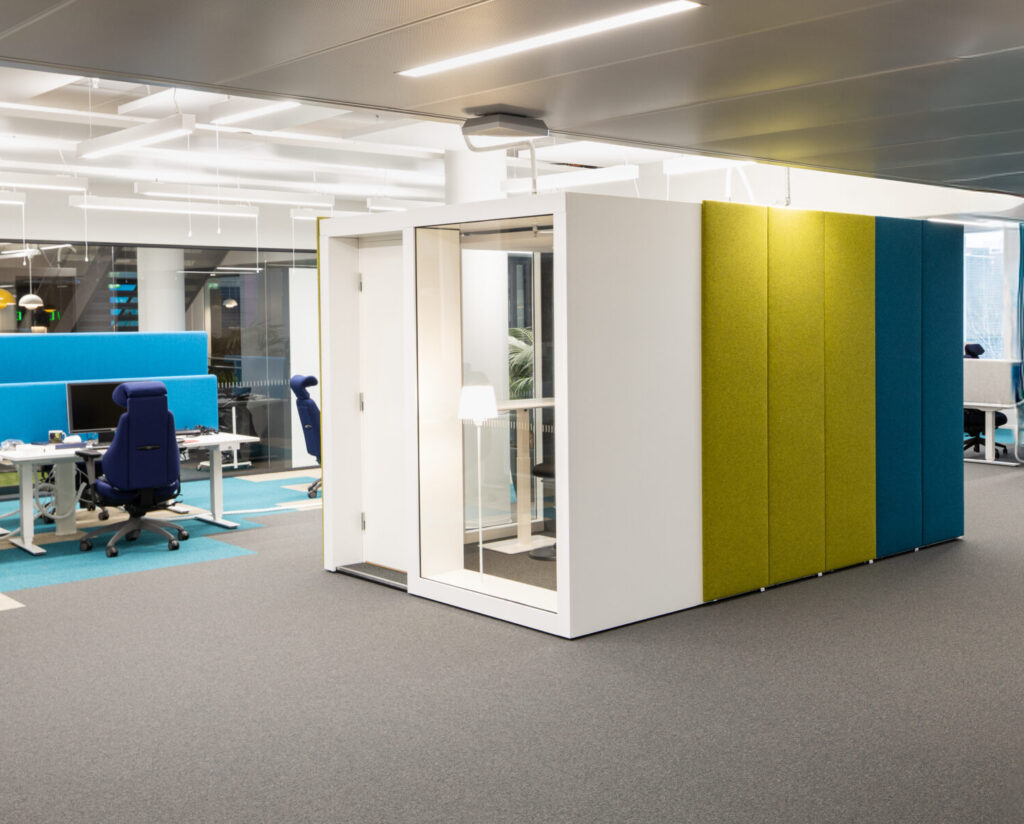
A space divider is a free-standing, mobile solution that divides space and improves the functionality of the working environment. A baffle, on the other hand, is a more traditional, often lighter partition that provides mainly visual separation. The key differences lie in construction, acoustic properties and function. In this article, we will explore how the two solutions differ and which is more suitable for different working environments.
What exactly is a space divider and what is it used for?
The space divider is free-standing furniture solution, which divides the space into functional areas without fixed structures. It is designed to improve both visual and acoustic separation in open spaces. Partitions are typically equipped with wheels, allowing them to be easily moved as required.
In modern working environments, space dividers meet the needs of a multi-space office. When different types of work - telephony, teamwork and work that requires concentration - are carried out in the same space, partitions help to create appropriate zones. This solution was developed to meet the challenge of open plan offices, where working with different work profiles in the same space caused a loss of concentration.
The design of the space dividers varies according to the intended use. The most common materials are acoustic felt surfaces, which absorb sound and reduce disturbing sound reflections. Curved shapes are used to break up sound waves and direct them away from workstations. Many partitions also include grooves for attaching accessories such as shelves or tables.
Practical applications can be found in a wide range of environments. In nurseries, partitions are used to separate dining and play areas, while children's art can be hung on felt surfaces. In offices, they create quiet areas for phone calls or tasks that require concentration. In educational establishments, partitions help provide flexibility to adapt spaces to different teaching situations.
What is a sermi and how does it differ from a space divider?
The Sermi is a traditional, often folding partition, originally designed to as a visual separator indoors. Historically, ceramics were used to add privacy to living spaces and were often decorative furniture. Nowadays they can also be found in office environments, but their main function is still visual delineation.
In terms of structure, a berm is typically lighter and simpler than a space divider. It often consists of frames and fabric or thin panels connected by hinges. This construction makes the baffle easy to fold and move, but at the same time it offers fewer acoustic properties.
There are several key differences between a space divider and a sermi. Room dividers are designed specifically for working environments with acoustic properties in mind, while baffles focus primarily on visual separation. Both are flexible in terms of mobility, but the lockable wheels of the room dividers make them more stable during use.
From a functional point of view, space dividers offer more versatile solutions. They can be fitted with accessories and their acoustic materials actively contribute to the soundscape of the working environment. Sermis, on the other hand, are often temporary solutions, used to quickly divide space without more permanent changes. In open-plan offices, baffles once created the illusion of a private room, but did not provide real soundproofing, leading to problems when users spoke loudly, oblivious to surrounding colleagues.
Which is better suited to an office environment: a room divider or a baffle?
When choosing an office environment a space divider is usually a better solution thanks to its acoustic properties and functionality. The Sermi is suitable for situations where fast, temporary visual separation is required without specific sound attenuation needs.
In terms of privacy, partitions provide both visual and acoustic protection. Privacy and a sense of security are important for concentration - a partition creates a visual barrier that prevents others from watching content on the screen, for example, while you work. Baffles provide only visual separation, but do not prevent sound from passing through.
From a space-use perspective, both solutions are flexible. Space dividers require a little more space due to their more stable design, but their lockable wheels keep them firmly in place during use. They can be folded down when needed, making them convenient for temporary use.
Ease of installation is a strength of both solutions - neither requires fixed installations. Space dividers are delivered ready to use and can be moved within the space as required. This flexibility is particularly important in multi-user offices where the use of the space can change throughout the day.
A key issue for decision-making is the intended use. If the aim is to create quiet areas for calls, meetings or tasks that require concentration, a room divider is an obvious choice. If the need is temporary and mainly related to visual separation, for example at an event or in a temporary space, a baffle may suffice. However, creating a functional multi-room environment requires versatile support spaces where acoustic properties play a key role.
What are the main advantages of room dividers and booms in workspaces?
The main advantage of space-sharing is acoustic insulation, which improves working peace in open spaces. Felt materials absorb sound, while curved shapes deflect sound waves away from workstations. This is particularly important in environments where different tasks are carried out simultaneously. Baffles do not provide the same acoustic benefit, but act as a visual boundary in lighter applications.
Visual privacy is a key advantage of both solutions. The partitions create a clear zone that gives workers a sense of privacy without solid walls. This enhances a sense of security and helps people to concentrate on their tasks. Berms offer a similar visual difference, but in a lighter way.
Structuring the space is essential for a functional working environment. Space dividers help to create clear areas for different activities - quiet zones for tasks that require concentration, collaborative areas for teamwork and phone areas without disturbing others. This supports the principle of a multi-space office, where employees are provided with a range of appropriate spaces to carry out different tasks.
Flexibility is the strength of both solutions. Space dividers can be easily moved as needed, allowing you to quickly adapt the space to different situations. Serms are even lighter and quicker to move, making them suitable for temporary use.
Aesthetics affects the comfort of the working environment. Space dividers are available in a range of finishes and colours to match the Nordic design style. Their felt surface can be covered with pictures or artwork, making them part of the interior design of the space. A well thought-out use of colour enhances comfort and has a positive impact on well-being at work.
The ergonomic and psychological effects are significant. When the working environment offers the possibility to choose the right space for the task, it supports different working styles and methods. An even and controlled sound environment calms the mind and improves concentration. Room dividers contribute to this goal by creating acoustically comfortable areas, while baffles offer a lighter solution for situations where acoustic requirements are less demanding.
The choice between a room divider and a screen ultimately depends on the use and needs of the room. In office environments, where acoustics and well-being at work are key, room dividers offer a more comprehensive solution. In temporary situations or for lighter applications, baffles can be an adequate and practical choice.