







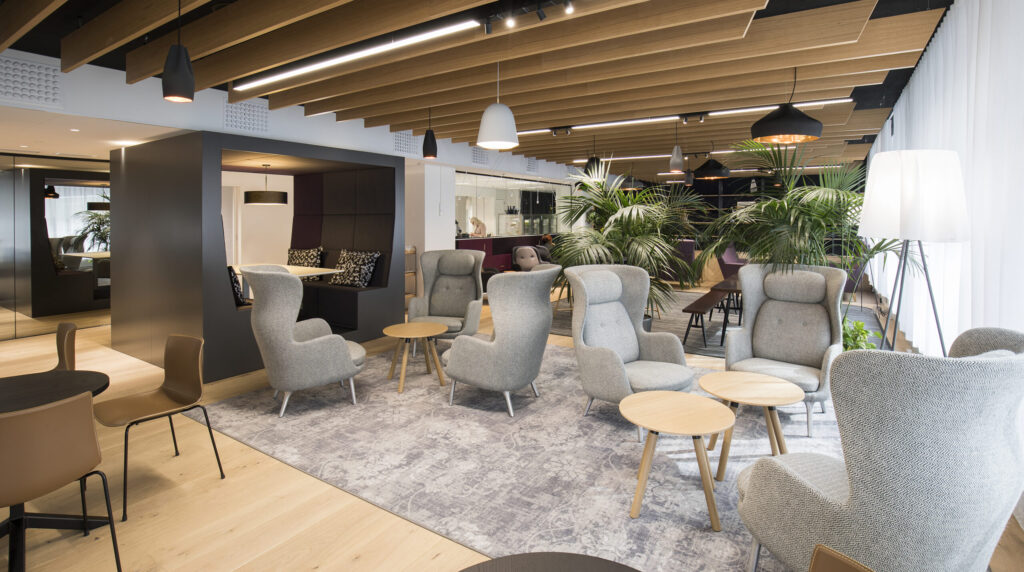
Soundproof booths are available in several different sizes depending on the intended use. Common sizes include single-person booths (approx. 1–1.5 m²), booths for 2–4 people (approx. 2–4 m²) and larger meeting booths for more than 4–6 people (over 4 m²). The choice of cubicle size depends primarily on the number of users, the intended use and the space available in the office.
What are soundproof booths and where are they needed?
Soundproof booths are separate spaces built within enclosed walls that provide acoustic protection open-plan office environment. They effectively insulate sound both in and out, enabling focused work and private conversations without disturbance. These office cubicles solve a key challenge in modern workspaces: how to combine the community spirit and space efficiency of an open-plan office with employees' need for privacy and peace and quiet.
In open-plan offices, ongoing conversations, phone calls and general noise can significantly interfere with work that requires concentration. A soundproof booth offers a solution by creating a peaceful space where employees can shut out external noise and focus entirely on the task at hand.
There are several uses for soundproof booths:
- Phone calls and video conferences: A private space for confidential calls without disturbing others or being heard throughout the office
- Focused work: A quiet environment for demanding tasks such as writing reports or analytical work
- Small meetings: For discussions between two or more people that require privacy
- Short meetings: Quick team discussions without having to book a meeting room
What are the most common sizes of soundproof booths?
Soundproof booths are typically divided into three main types according to the number of people and space requirements. Single cabins are the most compact solutions, with an area of approximately 1–1.5 square metres. These phone booths are designed for single-person use and are ideal for phone calls, video conferences and short periods of concentrated work. Their small footprint makes them easy to place even in cramped office spaces.
Cabinets for two or four people form the medium-sized category, and their surface area typically varies between 2 and 4 square metres. These acoustic workstations enable small teams to work together or two people to meet. They provide sufficient space for a table, seats and, if necessary, a small screen or presentation equipment.
The largest meeting booths are designed for 4-6 or more people and have a floor area of over 4 square metres. These serve as full-scale meeting rooms where team discussions, customer meetings or workshops can be held. The larger booths can accommodate a meeting table, several chairs and possibly also storage space.
When choosing the size of the cubicle, it is important to note that larger is not always better. An oversized cubicle takes up unnecessary floor space, while one that is too small feels cramped and uncomfortable during long-term use.
How to choose the right size cubicle for your office?
Choosing the right size soundproof booth begins mapping out usage needs. The first question is how many people will be using the booth at the same time. If it is mainly needed for phone calls and private work, a single-person booth will suffice. If the office regularly hosts small meetings or team discussions, a larger booth for 2–4 people will be more suitable.
Frequency of use also affects how many booths are needed and what size they should be. If there are many employees in the office who regularly need a quiet space, several smaller booths may be a more practical solution than one large one. This reduces queuing and ensures that everyone has access to a soundproofed space when needed.
The available space sets practical limits on the size of the cubicle. Before purchasing, it is advisable to carefully measure the area where the cubicle is to be placed. Also consider the passageways around the cubicle – sufficient free space facilitates movement and makes the office safer. When placing the cubicle, it is important to avoid locations that block natural passageways or take up space from key work areas.
When furnishing an office, it is worth considering the role of the cubicle as part of the whole. A soundproofed space works best when it complements other work areas and is not the only solution for privacy needs. The cubicle should be easily accessible, but not necessarily right in the centre of the office.
Practical tips for choosing the size of your cabin
- Count the number of employees in the office and estimate how many need a soundproofed space on a daily basis.
- Determine the most common use: is it for phone calls, focused work or small meetings?
- Measure the available floor space and leave at least one metre of free space around the cubicle.
- Consider purchasing several smaller cages instead of one large one to ensure better accessibility.
- Test different sizes if possible before making a final decision.
Does the size of the cabin affect sound insulation and acoustics?
The size of the booth has a significant impact on its acoustic properties both inside and outside. Larger cabins generally offer better sound insulation to the outside, as they have more space to use thicker structures and more sound-insulating layers. However, high-quality soundproof booths achieve an excellent level of insulation regardless of size when the materials and structure are designed correctly.
In smaller booths, controlling the acoustics inside requires special attention. In a compact space, sound wave reflections can cause echo problems, making speech sound unclear or causing uncomfortable reverberation. This is particularly important in telephone booths, where users talk a lot. High-quality single-person booths are equipped with sound-absorbing surfaces that reduce internal echo and create a pleasant acoustic environment.
In larger rooms for 2–4 people or meeting rooms, the internal acoustics are easier to control because the space itself absorbs sound better. However, even in these spaces, carefully designed acoustic solutions are needed to ensure that everyone in the cubicle can hear each other clearly without any distracting echoes.
Material choices play a key role in all size categories. The materials used for the walls, floor and ceiling determine how effectively the booth insulates sound and controls internal acoustics. High-quality soundproof booths use specialised acoustic materials that are optimised to both insulate and absorb sound effectively.
The size of the cubicle also affects ventilation and the noise it generates. In smaller cubicles, ventilation must be effective but quiet so that it does not disturb the user. In larger spaces, ventilation design is more critical, but noise control is generally easier due to the larger space.
Regardless of the size of the cubicle, a high-quality soundproofed space offers a significant improvement compared to the acoustic environment of an open-plan office. A properly selected and implemented cubicle creates a peaceful space where employees can concentrate on their tasks without being disturbed by outside noise, and where internal discussions remain private.