







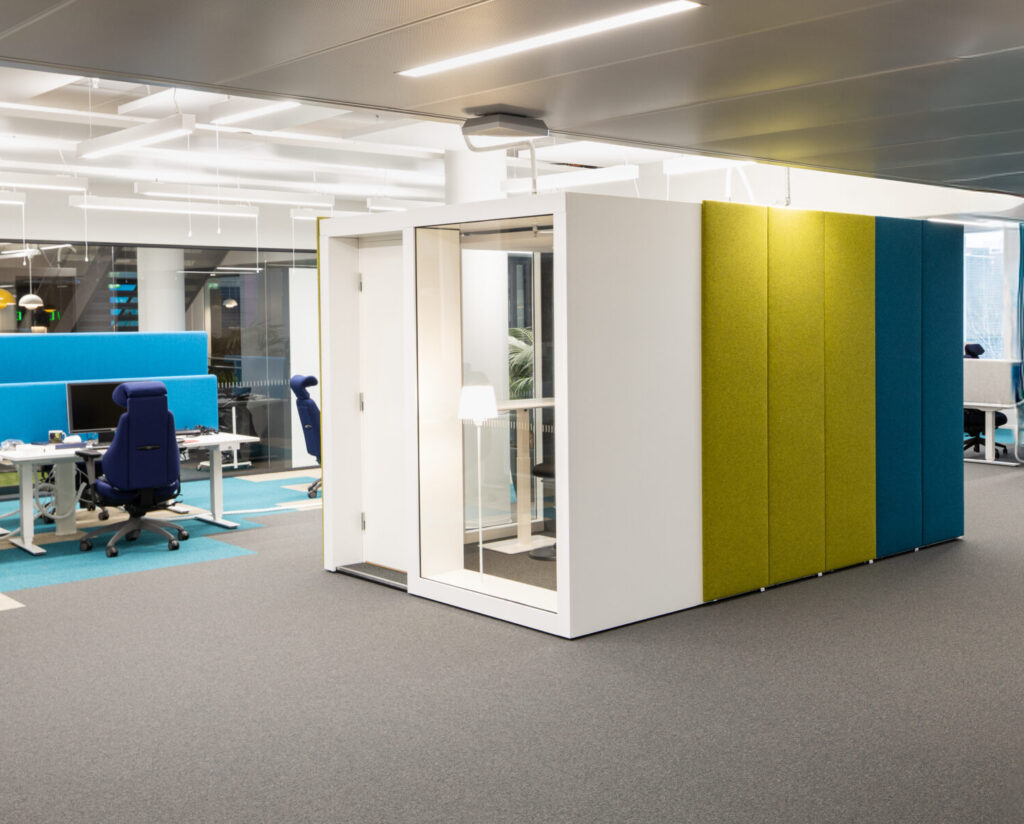
Acoustics is a critical factor in the functionality of open-plan offices, as a poorly designed sound environment significantly impairs employees' concentration and well-being. Sound behaves in challenging ways in open-plan workspaces: voices carry over long distances, hard surfaces cause echoes, and the constant background noise rises to a disturbing level. Acoustic solutions, such as room dividers and office cubicles, improve the soundscape of the working environment and create the conditions for efficient working.
What does acoustics mean in an open-plan office?
Acoustics in an open-plan office refers to how sound behaves in an open workspace. When there are no walls or other barriers in a space, sound waves travel freely and reflect off hard surfaces such as walls, ceilings and floors. This causes echoes and reverberations, which make the space distracting and difficult to concentrate in.
Acoustics are particularly challenging in open-plan offices, as several people with different job profiles work in the same space at the same time. Some are on the phone, others are focused on quiet work, and still others are participating in team meetings. When sound is not muffled or confined to a specific area, it disturbs everyone working in the space.
Reverberation time describes how long it takes for the sound pressure level to drop by 60 decibels. The longer the reverberation time, the more echoey the space is. Open-plan offices often suffer from long reverberation times, which makes the space uncomfortable and makes it harder to understand speech.
How does poor acoustics affect employee well-being?
Poor acoustics significantly impair employee well-being on many levels. Constantly listening to background noise and distracting sounds strains the brain, leading to rapid fatigue and a decline in concentration. When the brain is constantly filtering out unwanted sounds, cognitive load increases and performing the actual task requires more energy.
Stress increases when employees are unable to control their sound environment. Constant exposure to disruptive noises raises stress levels and can lead to long-term health effects such as insomnia and general malaise. Productivity declines as tasks take longer to complete and the number of errors increases.
The long-term effects can be serious. High background noise levels can cause permanent fatigue, reduce overall well-being at work and increase sick leave. Employees also feel a lack of privacy when they cannot have confidential conversations without others hearing them.
What are the most common acoustic problems in open-plan offices?
The most common acoustic problem in open-plan offices is speech sounds and conversations carrying over long distances. When colleagues chat amongst themselves or talk on the phone, the sound disturbs everyone working nearby. The brain automatically tries to follow the conversations and understand what is being said, which breaks concentration.
Video conferencing and telephone booths cause problems if the rooms are not acoustically insulated. When an office cubicle does not dampen sound sufficiently, conversations held in meetings can be heard outside the room, which disturbs others and compromises privacy.
Device sounds, such as printers, ventilation and computers, create constant background noise. Although individual sounds are not very loud, their combined effect raises the noise level to a disturbing level. Echo occurs when sound is reflected off hard surfaces and returns to the space multiple times.
Sounds carrying over long distances is a problem especially in large open spaces where there are insufficient sound-absorbing elements. Lack of privacy This is particularly evident when employees are unable to make confidential phone calls or have confidential conversations without others overhearing them.
How can acoustics be improved in an open-plan office?
Acoustics can be improved by using acoustic panels and walls, which absorb sound energy and reduce reverberation. The panels can be installed on walls or ceilings and are particularly effective at reducing reverberation time and improving speech clarity in a room.
Room dividers and screens provide visual and acoustic protection for workstations. They prevent sound from spreading freely throughout the space and give employees a sense of privacy. Space dividers work well between individual workstations when you want to create quieter working areas.
Acoustic ceiling panels are an effective solution because they reduce the amount of sound reflected from above. The ceiling is one of the most important surfaces in terms of acoustics, and treating it significantly improves the sound environment of a space.
Furniture solutions, such as office cubicles and acoustic workstations, offer a comprehensive solution. An office cubicle creates a completely isolated space for phone calls and video conferences, while an acoustic workstation provides a quiet place for work that requires concentration. These solutions improve not only the acoustics but also the functionality of the space.
Principles of space planning are key. Spaces should be designed so that noisy activities, such as teamwork and meetings, are separated from quiet work areas. This reduces distractions and creates better conditions for different types of work.
How do acoustic solutions affect the appearance of a workspace?
Modern acoustic solutions seamlessly combine functionality and aesthetics. Nordic design emphasises clean lines, a minimalist look and high-quality materials, making acoustic elements part of the visual identity of a space rather than just a technical addition.
The choice of materials affects both acoustics and appearance. High-quality fabrics, wood and other natural materials bring warmth to a space and suit a variety of interior design styles. The colour scheme can be chosen to match the overall look of the space, making acoustic solutions a harmonious part of the whole.
Acoustics and design combine at their best in such a way that the solutions improve the visual appearance of the space while reducing disturbing noises. Room dividers can serve as space organisers and create visual interest, while office cubicles bring architectural appeal to open spaces. Acoustic elements are no longer hidden necessities, but can be aesthetic focal points in a space.
When should you consider purchasing acoustic solutions?
It is worth considering purchasing acoustic solutions when employees complain about constant noise or difficulty concentrating. If there are repeated comments in the office about difficulty concentrating or being disturbed by phone calls, it is time to assess the acoustics of the space. Feedback from employees is the most important indicator of acoustic problems in a space.
Productivity problems are another clear sign. When tasks take longer than expected to complete or the number of errors increases, poor acoustics may be the cause. If employees regularly seek out other places to work or constantly use headphones, the space does not provide adequate acoustic comfort.
Designing a new office is the ideal time to consider acoustics from the outset. When spaces are designed with functionality and sound in mind, costly retroactive repairs can be avoided. Renovating an office is also a good opportunity to improve acoustics and update the space to meet modern needs.
The need for acoustic improvements can be assessed by listening while working in the space. If voices can be heard clearly at workstations far away, there is noticeable echo, or private conversations are not private, the space has acoustic deficiencies. The Speech Transmission Index (STI) indicates speech intelligibility: when the value is high in an open space, speech intelligibility is too good and privacy suffers.