








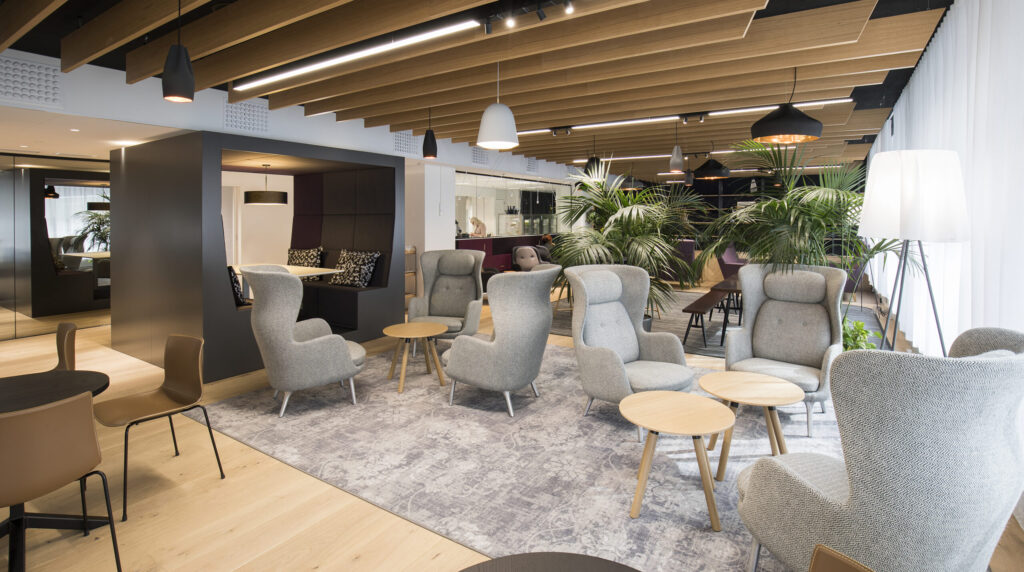
Acoustic solutions improve well-being at work by reducing noise and distractions that cause stress and impair concentration. Effective soundproofed spaces and acoustic workstations create a peaceful working environment where employees can perform their tasks more efficiently. Good acoustics support both deep work and collaboration, as there is a suitable space for every way of working.
What do acoustic solutions mean in the workplace?
Acoustic solutions are products and structures that control the sound environment in workspaces by absorbing noise and reducing echo. They absorb sound energy and prevent sound from reflecting off surfaces, making the space more pleasant and functional for working.
Acoustic solutions for work environments include acoustic panels, room dividers and soundproof booths. Room dividers create a peaceful working environment by effectively dampening sound between teams, while soundproofed rooms offer complete privacy for telephone conversations and tasks requiring concentration.
Acoustic furnishings, such as upholstered seats and workstations, function in the same way by absorbing sound energy. These solutions work by using materials that absorb sound waves rather than reflecting them back into the space. When sound hits an acoustic surface, some of the energy is absorbed by the material and some is dissipated, reducing the overall noise level in the space.
How does poor acoustics affect employee well-being?
Poor acoustics cause significant stress and constantly strain employees. When background noise is high, the brain has to use energy to filter out unnecessary sounds, leading to rapid fatigue and impaired concentration. If this continues for a long time, it can have serious health consequences.
People who work in open-plan offices often feel lack of industrial peace, when there is constant chatter and noise from electrical equipment around you. This is particularly disruptive for tasks that require concentration, such as analysis, writing or planning. When concentration is repeatedly interrupted, employee productivity declines and errors increase.
Communication problems are another significant consequence. When the acoustics in a space are poor, speech is difficult to understand and conversations require extra effort. This is both physically and mentally taxing. The lack of privacy adds to the stress, as employees are unable to have confidential conversations in peace or feel that they are constantly being watched by others.
Long-term health effects can include insomnia, headaches and a decline in general well-being. Constant noise levels raise stress hormone levels, which has a negative impact on both physical and mental health.
What are the most common acoustic problems in open-plan offices?
The most common acoustic problem in open-plan offices is constant background noise, which consists of people talking, computers humming and ventilation systems whirring. This overall noise is not necessarily particularly loud, but its constant presence disrupts concentration and causes fatigue during the working day.
Telephone conversations are another significant challenge. When employees make calls from their own workstations, the conversations can be heard over a wide area and disturb others' work. Soundproof booth solves this problem by providing a space where calls can be handled without disturbing others.
Echo problems arise when there are many hard surfaces in a room, such as glass, concrete or stone. These materials reflect sound back into the room instead of absorbing it. When sound is reflected off surfaces, it makes the space feel echoey and unpleasant. Reverberation time tells you how long sound stays in the space before it fades away.
The lack of privacy is particularly problematic when work tasks require confidentiality. In open-plan offices, it is difficult to have private conversations or meetings when everything can be heard from the neighbouring workstation. This has a negative impact on both employees' sense of security and the company's information security.
How do acoustic solutions improve concentration and productivity?
Acoustic solutions improve concentration by reducing distractions that interrupt the flow of thought. When noise levels are reduced, the brain can focus on the task at hand instead of constantly filtering out background noise. This supports deep work, where employees can enter a state of flow and achieve their best performance.
Tasks that require concentration, such as programming, writing or analysing, benefit particularly from quiet environments. acoustic workstations. When employees have the opportunity to retreat to a quiet space, they can work efficiently without interruptions. This is directly reflected in the quality and speed of their work.
Tasks that require collaboration benefit from spaces where the acoustics are designed to support conversation. When a space is not too echoey, speech is clear and easy to understand. This makes meetings and teamwork smoother and more efficient.
The acoustic requirements of different types of work vary significantly. Analytical work requires a quiet environment, while creative collaboration benefits from a space where communication is easy but does not disturb others. For a functional working environment, it is important that office furnishing take these different needs into account and provide suitable facilities for both purposes.
What kind of acoustic solutions should you consider for your office?
Acoustic panels can be installed on walls and ceilings to absorb sound and reduce echo. They are particularly suitable for rooms with many hard surfaces and excessive reverberation time. Panels are an effective way to improve the overall acoustics of a room without major structural changes.
Room dividers serve as both visual barriers and sound absorbers. They create quieter working areas in open-plan offices and help to divide the space for different purposes. Acoustic room dividers are particularly useful when you want to separate teams from each other or create smaller areas for concentration.
Soundproof booths offer the perfect solution for telephone conversations and private meetings. These high-quality booths are classified as acoustic class A, and their speech transmission index (STI) has been measured at a normal speech level between 0.10 and 0.15. This means that speech intelligibility outside the booth is poor and privacy is maintained.
Acoustic furnishings, such as upholstered seats and sofas, absorb sound energy and make the space more pleasant. They are particularly suitable for communal areas, kitchen areas and informal meeting places where interaction is encouraged but noise levels need to be kept under control.
When choosing solutions, it is important to consider the size of the space, its intended use and the needs of employees. In a small office, a few well-placed panels and a single telephone booth may suffice, while a larger open-plan office will benefit from a more comprehensive design that combines several different solutions.
How do you know if your work environment needs acoustic improvements?
Feedback from employees is the most important indicator of the need for acoustic improvements. If staff complain about noise, difficulty concentrating or say they cannot find a quiet place to make phone calls, there are likely to be acoustic problems in the space. It is worth listening carefully to the challenges employees experience in their daily work.
The problems you notice say a lot about the acoustics of the space. If there is clear echo in the space, speech carries far, or background noise is constantly high, the acoustics need improvement. A lack of privacy is evident when it is difficult to have conversations without disturbing others or without everyone hearing everything.
The type of work and the intended use of the space affect the acoustic requirements. If the office involves a lot of work that requires concentration, such as analysis or writing, good acoustics are essential. Similarly, if the work involves a lot of telephone conversations or video conferences, soundproofed rooms are necessary.
Practical tips for assessing acoustic needs: Walk around the office at different times of the day and listen to the soundscape. Ask employees where they prefer to work and why. Notice whether people use headphones constantly or are able to work without them. If headphones are a necessity, the acoustics need improvement.
The next steps depend on the findings. Small changes, such as room dividers and acoustic panels, can often achieve significant improvements. For larger projects, it is worth designing a more comprehensive solution that takes different working methods into account and offers versatile spaces for different needs.