








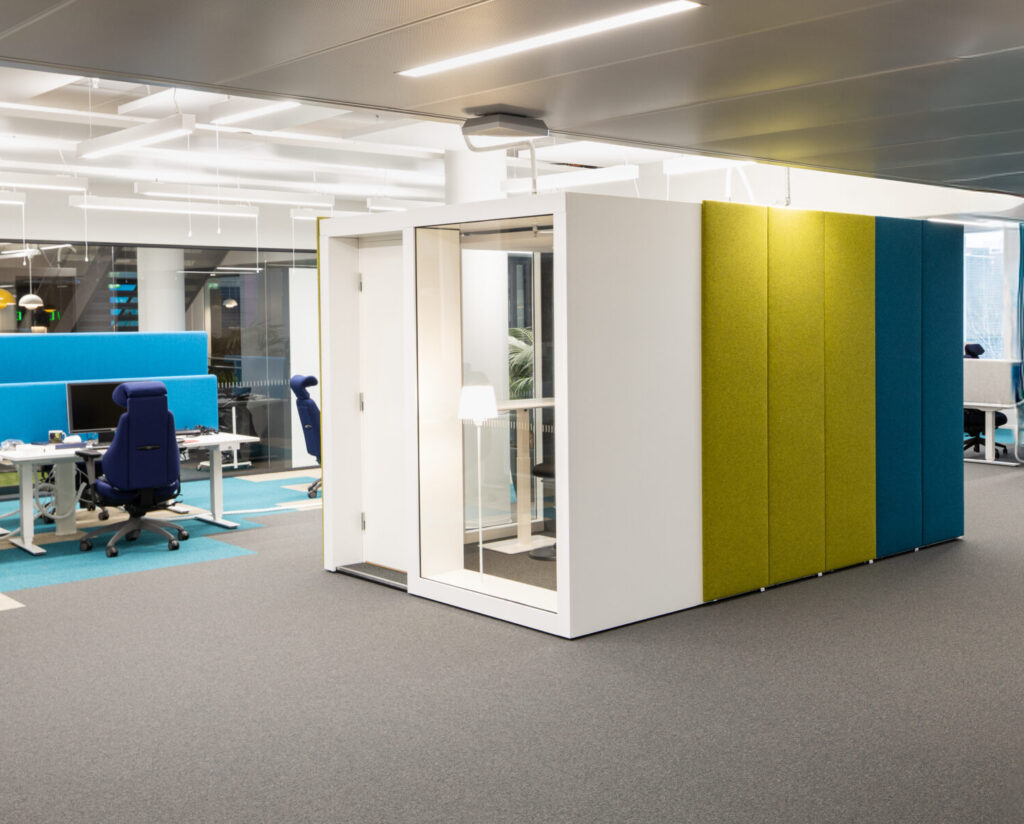
Acoustic workstations improve concentration by creating a soundproof and visually protected space that reduces distractions in open-plan office environments. These individual workstations dampen background noise and conversations, allowing for deeper concentration on demanding tasks. Acoustic solutions provide employees with a place where they can work without the constant stress of ambient noise.
What is an acoustic workstation and why is it important?
An acoustic workstation is a specially designed workspace that reduces sound transmission and creates a peaceful environment for tasks that require concentration. These workstations utilise sound-absorbing materials and design solutions that effectively absorb sound and improve the acoustics of the space. An acoustic workstation provides both visual privacy and quiet for working.
In open-plan offices and shared spaces, the biggest challenge is constant background noise, which has a negative impact on the quality and efficiency of work. When several people with different job profiles work in the same space, distractions are inevitable. Telephone conversations, teamwork noises and general office noises make it particularly difficult to perform tasks that require deep thought or attention to detail.
Acoustic workstations solve this problem by creating spaces where employees can isolate themselves from the noise of an open-plan office for a moment. They are not just physical barriers, but comprehensive solutions that take into account both the sound environment and the ergonomics of working. These individual workstations have become essential in multi-space offices, where there is a recognised need to provide employees with a selection of different spaces for performing various tasks.
How does noise affect concentration and work quality?
Noise affects concentration by interrupting the flow of thought and forcing the brain to constantly process unwanted sounds. Speech sounds are particularly distracting because our brains interpret them automatically, even when we are not actively listening to the conversation. This constant distraction leads to mental fatigue and significantly impairs the quality of our work.
Different types of noise affect concentration in different ways. Sudden noises, such as telephone ringing or laughter, immediately interrupt concentration. Constant background noise, such as the hum of air conditioning or distant voices, causes long-term stress, which imperceptibly reduces work efficiency. Conversations in the immediate environment are particularly challenging because they contain informative content that our brains try to process without our consent.
Loss of concentration does not only affect the moment of working. Studies show that restoring focus After an interruption, it takes time to get back on track, and this time adds up significantly over the course of a day. When employees are constantly forced to return to their tasks after interruptions, fatigue increases and the number of errors rises. A sense of privacy and security also affects concentration. When someone stands behind you reading an email you have just written, or private conversations can be heard from the next room, your peace of mind at work is significantly disturbed.
What are the most important features of an acoustic workstation?
The most important features of an effective acoustic workstation are sound-absorbing materials, visual protection and ergonomic design. Sound-absorbing surfaces, such as felt coverings, effectively absorb sound and prevent it from being reflected back into the room. Spatial design creates a physical barrier that reduces the transmission of both sound and visual disturbances.
Acoustic workstations use porous absorbers made of materials that allow sound waves to pass through and be absorbed. Upholstery on the inside and outside creates a sound-friendly and peaceful environment for the user. This double damping improves both the internal acoustics of the workstation and reduces sound propagation into the surrounding space.
Visual protection is just as important as sound insulation. High side panels or closed structures at workstations provide privacy and reduce visual distractions, which can disrupt concentration just as effectively as noise. This creates a sense of security that is essential for deep concentration.
Functional elements complement the acoustic properties. Integrated lighting, sockets for charging electrical devices and ergonomic work surfaces make the workstation a fully functional working environment. Mobility thanks to castors allows for flexible arrangement of the space according to needs. These features combine to create an environment where employees can focus fully on their work without external distractions.
Who is an acoustic workstation best suited for?
Acoustic workstations are best suited for knowledge workers, who need to concentrate on demanding tasks such as writing, analysis or planning. Those who work in open-plan offices in particular benefit from these solutions when they need a moment of complete peace and quiet. Individual workstations provide a place where you can shut out the noise of your surroundings without having to move to a completely separate space.
Creative professionals, such as designers and developers, benefit from acoustic workstations, especially when working on demanding projects. Deep concentration is essential for the creative process, and constant interruptions can break the flow of thought at a critical moment. An acoustic workstation provides protection that enables uninterrupted work sessions.
Employees who make private calls appreciate acoustic solutions because they offer both privacy and sound insulation. When you make a private call in an open-plan office, an acoustic workstation ensures that the conversation cannot be heard in the surrounding space and that background noise does not interfere with the call. The speech transmission index indicates how well a space insulates speech, and a low value means that even private conversations can be held in the space without concern.
Employees who perform detailed work, such as financial management or legal affairs, also need an environment where errors are minimised. An acoustic workstation creates conditions in which you can concentrate fully on the task at hand without background noise causing harmful long-term effects such as fatigue or reduced efficiency.
How to choose the right acoustic solution for your work environment?
Choosing the right acoustic solution begins assessment of workplace needs. Identify which tasks require the most concentration and how often employees need a quiet space. If an open-plan office involves a lot of phone work and tasks that require concentration at the same time, the need for acoustic solutions is obvious. Also, assess how many people need these spaces on a daily basis.
Space utilisation and physical constraints affect the choice of solution. Acoustic workstations can vary in size and shape, from small individual workstations to larger telephone booths. Assess the available space and consider whether you need mobile solutions that allow for flexible space arrangement. Workstations equipped with wheels are suitable for spaces where the layout changes according to needs.
Assessing acoustic properties is essential. Investigate how different solutions dampen sound and what their speech transmission index is. This value tells you more about the sound environment of a space than individual sound attenuation values. A low speech transmission index means that speech is difficult to understand outside the space, which is a desirable feature in workplaces where privacy is important.
Consider practical functionality as well. Does the workstation require integrated lighting, power sockets or work surfaces? Does the solution offer both visual privacy and sound insulation? A comprehensive assessment ensures that the chosen solution meets real needs and improves the functionality of the working environment in the long term. The right acoustic solution creates a working environment where concentration and peace and quiet are possible without compromise.