







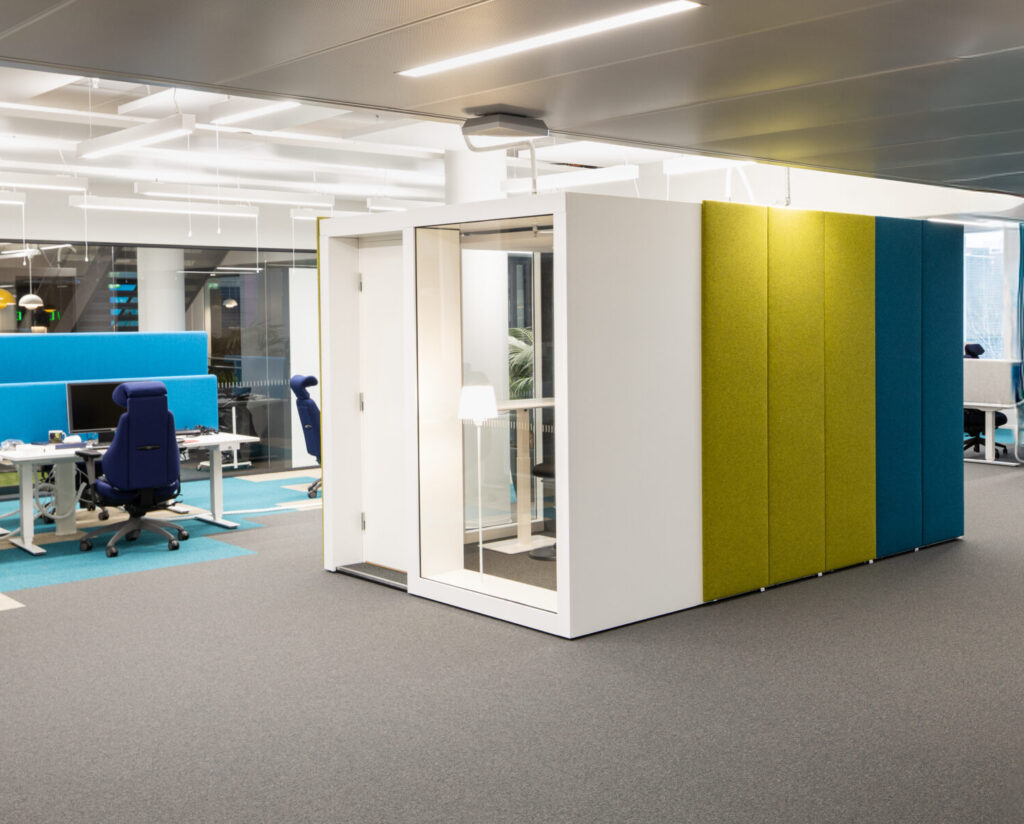
A soundproofed workspace improves concentration by preventing external noises from disturbing work and creating a peaceful environment where the brain can process information efficiently. When background noise does not consume brain capacity, employees can concentrate deeply and perform better in demanding tasks. In this article, we discuss why soundproofed workspace is an effective solution and how it supports work quality and productivity.
What makes a soundproofed workspace effective for concentration?
A soundproofed workspace prevents external noise from entering the space and internal noise from escaping, creating an optimal environment for deep concentration. When the brain does not have to constantly filter out background noise, it can focus entirely on the task at hand. This significantly improves the ability to process complex information and solve demanding problems.
The effectiveness of sound insulation is based on the fact that sound waves are prevented from travelling through physical structures. When the speech transmission index (STI) is low, for example between 0.10 and 0.15, speech intelligibility outside the room is poor. This means that individual syllables, words and sentences are difficult to understand, ensuring both privacy and undisturbed work.
In terms of cognitive performance quiet workspace is essential when a task requires prolonged concentration. Noise levels directly affect how efficiently the brain's working memory functions and how well we are able to retain information in our minds while working. In a soundproofed space, employees can enter a state of flow, where they can work without interruption and productively.
How does noise affect the quality and productivity of work?
Background noise causes constant interruptions, which impair concentration and increase the number of errors made at work. In open-plan office environments, the brain has to expend extra energy filtering out noise, which reduces the capacity available for the actual task at hand. This leads to faster fatigue and significantly reduces the quality of work.
When an employee works in a noisy environment, it is difficult for them to concentrate deeply. Conversations between colleagues, phone calls and other office noises repeatedly interrupt their train of thought. Each interruption takes time and energy, as the employee has to return to where they were before the interruption.
Excessive noise in open-plan offices can also lead to increased stress levels and general dissatisfaction with the working environment. When employees are unable to control their environment and its soundscape, they feel powerless and frustrated. This has a direct impact on work motivation and commitment. A soundproofed workspace offers a solution to these challenges by creating a controllable and predictable working environment.
What types of work tasks should be performed in a soundproofed space?
Analytical work, such as data analysis, report writing and financial calculations, benefits particularly from a soundproofed environment. These tasks require deep concentration and the ability to process complex data sets without interruption. In a soundproofed space, employees can immerse themselves completely in their work and achieve the best possible results.
Creative design and strategic thinking are most successful in a peaceful environment. When brainstorming new concepts, developing products or planning long-term strategies, you need space for your thoughts without external distractions. A soundproofed workspace allows you to focus on the internal process and develop your own ideas.
Important phone calls and video conferences require an environment where conversations remain confidential and both parties can hear each other clearly. A soundproof phone booth ensures that background noise does not interfere with the conversation and that other office workers cannot hear sensitive matters. This is particularly important for customer calls, personnel matters and strategic negotiations.
Tasks that require learning and training, such as learning new software or professional development, are also more successful in an undisturbed environment. When employees can focus entirely on acquiring new knowledge, learning is more effective and lasting.
What is the difference between sound insulation and soundproofing in workspaces?
Sound insulation prevents sound from entering and leaving a space through physical structures, while sound absorption improves the internal acoustics of a space by reducing reverberation and sound reflection. Both are important in creating an optimal working environment, but they serve different purposes and complement each other.
Sound insulation is achieved through a dense structure that forms a barrier to sound waves. When a sound wave hits a soundproofed wall or door, only a small portion of the energy is able to pass through the material. High-quality sound insulation ensures that outside noises do not disturb work and that conversations inside the room remain confidential.
Sound absorption, on the other hand, deals with how sound behaves within a space. When a sound wave hits the boundaries of a room, some of the sound energy is absorbed by the material, some passes through it, and some is reflected back into the space. Absorption reduces reverberation and improves speech intelligibility in the space. Reverberation time indicates how quickly sound is absorbed in the space.
Both elements are taken into account in a functional soundproofed workspace. Good soundproofing protects against external disturbances, while internal sound absorption ensures that the acoustics of the space are pleasant and that, for example, video calls can be heard clearly without echo. Together, these factors create an optimal environment for work that requires concentration.
How do you choose the right soundproofed workspace for your needs?
The size is determined by analysing the usage needs. A single-person telephone booth is sufficient for quick calls and short periods of concentrated work, while a larger workspace is suitable for longer work periods and possibly for use by two people. Consider how many people will be using the space at the same time and what kind of work will be done there.
Assessing acoustic properties is essential. Check that the space meets the requirements of standard SFS 5904 for sound classification and that the speech transmission index (STI) is sufficiently low. This ensures true privacy and effective sound insulation. Visual insulation alone is not enough; a real barrier to sound transmission is needed.
The layout of an office affects how well the space serves its users. Place soundproofed workspaces in easily accessible locations, but not in main traffic areas. Also note that the spaces should be equally accessible to all employees. Good placement encourages regular use of the spaces.
Ventilation and lighting are important for long-term use. Ensure that the space has effective ventilation that keeps the air fresh even during longer work periods. The lighting should be sufficiently bright and adjustable for different tasks. Poor air quality or poor lighting makes a space uncomfortable, no matter how good the sound insulation is.
Ergonomics and comfort affect how efficiently space is used. Choose adjustable workstations that suit users of different heights and allow for both sitting and standing work. A comfortable seat supports long-term concentration, and sufficient workspace allows for the use of necessary work tools. When a space is both functional and pleasant, employees want to use it regularly.
A soundproofed workspace is an investment in employee wellbeing and productivity. By choosing the right solution for your needs, you can create an environment that promotes deep concentration and high-quality work. Careful planning and evaluation of the right features ensure that the space serves its users effectively and encourages them to take advantage of the opportunities for peaceful work every day.