








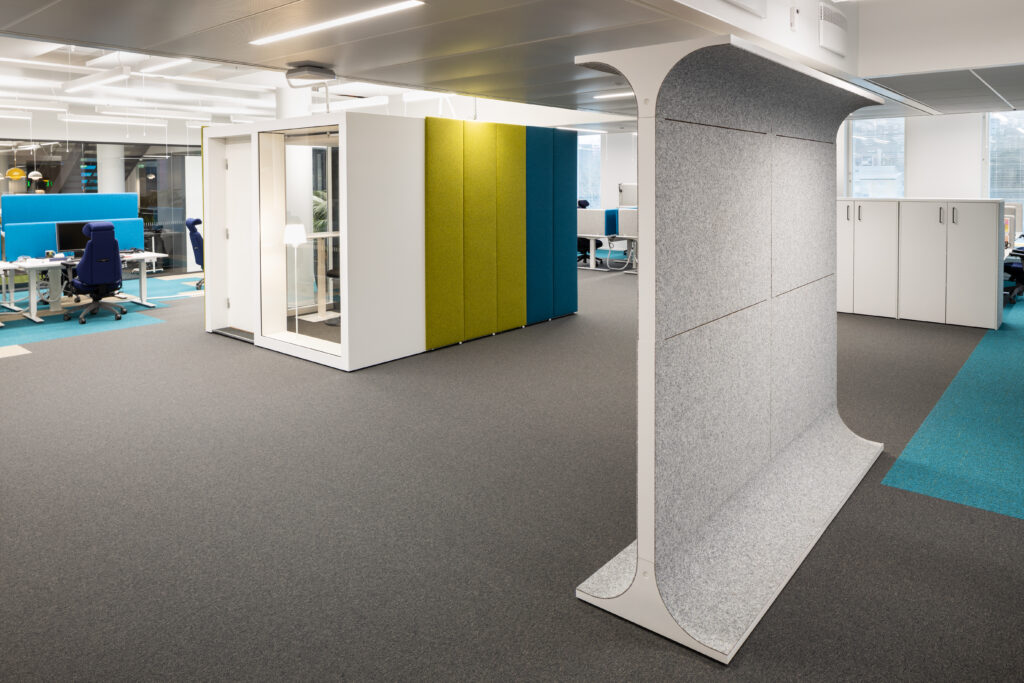
Workstation soundproofing is effectively achieved by combining various acoustic elements. Key solutions include acoustic walls, sound-absorbing panels, soundproof POD rooms and room dividers. In addition to these, the placement of workstations, the acoustic properties of furniture and the overall design of the working environment can significantly reduce noise disturbances. Good sound insulation improves employees' ability to concentrate, increases work efficiency and promotes well-being at work.
How is sound insulation implemented at the workstation?
In modern work environments, sound insulation is becoming increasingly important, as open-plan offices often house people with different job profiles. Typical challenges in open-plan offices, such as background noise and various distracting sounds, can significantly reduce employee productivity and concentration. At its most effective, sound insulation for workstations provides individual acoustic protection without compromising the benefits of collaboration and communication.
The basic elements of workstation sound insulation are various types of partitions that visually and acoustically separate the space. The height, material and placement of the partitions directly affect their effectiveness in dampening sound waves. Acoustic panels, on the other hand, effectively absorb sound and reduce reverberation in rooms.
When you need complete sound insulation for phone calls or tasks that require concentration, POD rooms offer the ideal solution. These modern telephone booths and retreats are convenient because their acoustic properties match the sound insulation of traditional, fixed meeting rooms.
The importance of soundproofing workstations for well-being at work is undeniable. Studies show that constant interruptions and noise can significantly reduce employees' stamina and the quality of their work. Therefore, soundproofing should be seen as an investment in productivity and job satisfaction.
What materials are used for effective sound insulation?
When it comes to soundproofing solutions, the choice of materials is crucial to their effectiveness. Acoustic materials have the ability to absorb and dampen sound, converting sound energy into heat. These materials can not only reduce noise, but also make the overall acoustics of a space more pleasant.
Acoustic panels are typically made from porous materials such as mineral wool or recycled fibres. Various fabrics or other finishes can be added to their surface without compromising their sound-absorbing properties. The sound absorption capacity of such panels is classified according to standard EN ISO 11654 into categories A-E, with category A products having the best absorption capacity.
Ecologically sustainable materials are particularly in demand today. Acoustic panels made from recycled PET bottles are an example of an innovative and environmentally friendly solution that offers excellent acoustic properties. We also use ecological wood fibres and biocomposites in our products.
Space sharing and POD room structures often combine different materials to achieve optimal sound insulation. Absorbent materials are used both on interior surfaces to absorb sound and in structures to prevent sound transmission. Placement of acoustic panels also has a significant impact on their effectiveness – when positioned correctly, even a small amount of material can significantly improve the acoustics of a room.
How do POD rooms improve office acoustics?
POD rooms have revolutionised office sound management by providing compact, soundproofed spaces in the middle of open-plan offices. These modern solutions enable private phone calls, video conferences and tasks that require concentration without surrounding noise disturbing work or conversations disturbing others.
The structure of POD rooms is designed to maximise sound insulation. The wall elements consist of several layers that together prevent sound from travelling both in and out. Measurements show that high-quality POD rooms offer sound insulation equivalent to that of a traditional fixed meeting room with double plasterboard and a 100-millimetre-thick insulation layer.
We have developed internal acoustic elements for our POD rooms to ensure that the room's internal acoustics are also pleasant. This means, for example, that telephone conversations can be heard clearly without echoes or other factors that impair sound quality.
The versatility of POD rooms is evident in their suitability for a variety of work environments. In small offices, they can serve as meeting rooms, while in larger environments they offer privacy for moments that require concentration. POD rooms are also easily movable, making them an ideal solution for changing space requirements.
How can room dividers improve sound insulation?
Room dividers are versatile elements that can be used to effectively control the acoustics of an office space. They not only divide the space physically, but also act as elements that control and absorb sound waves. Room dividers are particularly useful in open-plan working environments where flexibility in room layout is required.
Movable partitions offer an immediate solution for improving sound insulation. They can be moved as needed and adapted to the requirements of different work situations. Taller partitions provide more effective sound insulation, while shorter ones can serve as visual dividers while still maintaining an open atmosphere.
More permanent partition solutions, such as modular systems, enable entire work areas to be isolated. The advantage of these systems is their high sound insulation capacity combined with easy adaptability. Acoustic measurements show that well-designed room dividers can disperse sound much more effectively than a completely open space.
The importance of modularity is emphasised in modern office solutions. We offer room dividers that can be easily combined with other furniture to create flexible and acoustically functional working environments. This is particularly valuable in rapidly changing working environments where the use of space can vary from day to day.
How do seating furniture and workstations affect acoustics?
The importance of seating and workstations in office acoustics is often underestimated. Acoustic seating, such as high-back sofas and armchairs, not only provides a comfortable working environment, but also acts as an effective sound-absorbing element. Measurements show that people sitting opposite each other can converse comfortably, but behind the back of the sofa, normal speech is only faintly audible.
Acoustic properties can be taken into account in many ways when designing desks and workstations. Desk partitions are an effective way to reduce sound transmission between workstations. In addition, the choice of materials for desk surfaces can affect sound reflection and attenuation.
Combining ergonomics and acoustics is the basis of smart workstation design. A well-designed workstation supports both physical and acoustic well-being. Adjustable desks allow for variation in working posture, which reduces physical strain, while integrated acoustic solutions improve concentration.
The versatility of our acoustic furniture enables the creation of comprehensive working environments that take both privacy and collaboration into account. For example, our acoustic workstation islands combine ergonomic workstations with effective sound insulation, providing the ideal space for tasks that require concentration, even in open-plan environments.
The future of sound insulation solutions in work environments
Soundproofing solutions for work environments are constantly evolving to meet changing work styles and needs. Technological advances are bringing increasingly intelligent acoustic solutions to the market that automatically adapt to the use of the space and the sound environment. For example, in the future, smart acoustic panels will be able to adjust their sound absorption properties according to the intended use of the space.
The rise of remote and hybrid working has brought new challenges to workplace acoustics. Offices have become more like meeting places, with a significant increase in the number of video conferences. This creates a need for spaces where virtual meetings can be held without disruption and where sound quality is optimal.
Sustainability considerations are also becoming increasingly important in acoustic solutions. We are committed to developing environmentally friendly products that use recycled and recyclable materials. At the same time, we are looking for innovative ways to improve the acoustic properties of our products without increasing their environmental impact.
The importance of a flexible working environment will become even more important in the future. We offer solutions that adapt to changing needs and enable different working styles to be supported in the same space. We believe that well-designed acoustics are a key part of a healthy and productive working environment.
Take a look at a our references and be inspired by the projects that have been implemented - contact us, and together we will find the solution that suits you best!