








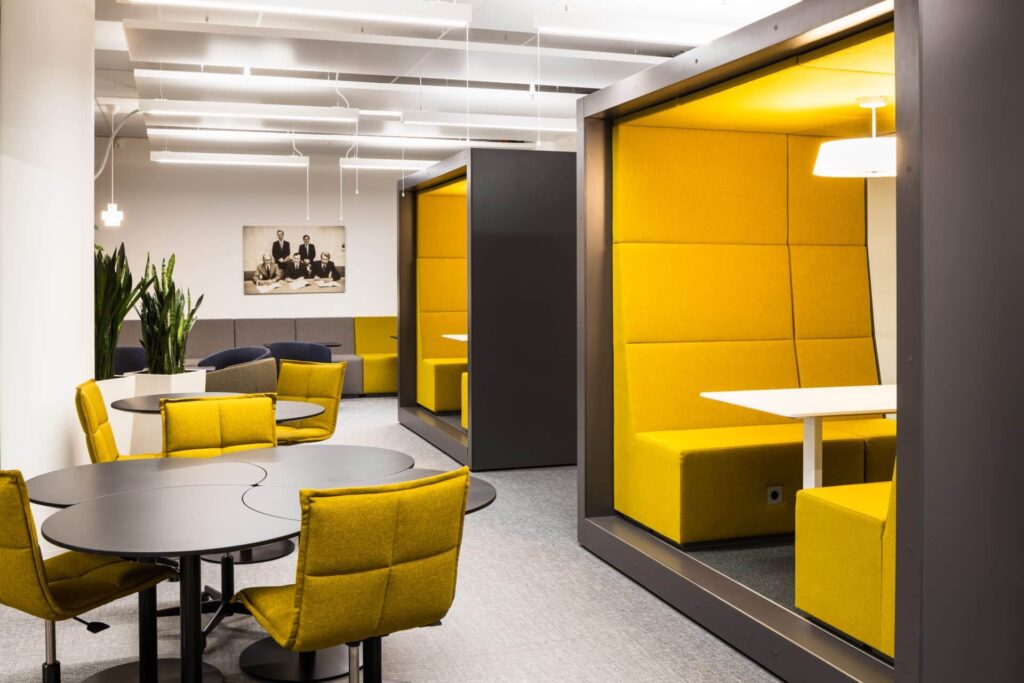
Modern office furniture plays a key role in creating work spaces that support concentration. The right furniture solutions can significantly improve acoustics, provide privacy and create zones for different working needs. The most effective solutions are sound-absorbing POD rooms, acoustic partitions, soundproof seating and ergonomic workstations. These elements combine to create a working environment where concentration is possible even in open spaces.
Why are quiet spaces important in a modern office?
Quiet spaces have become an essential part of an efficient working environment. Studies show that workers in open plan offices lose an average of 86 minutes of their working day to various interruptions and environmental distractions. This has a direct impact on workers' productivity, stress levels and job satisfaction.
The ability to control your own soundscape is an important factor for well-being and concentration at work. Up to 53% of workers report that noise is the most significant distraction in the work environment. This is particularly true for tasks requiring deep concentration or creative thinking.
Open offices became more common in the 90s to increase efficiency and community. However, it soon became apparent that very different types of work were being carried out in the same space: telephone work, team work and work requiring concentration. This led to the multi-space office model, where employees are provided with different spaces to carry out different tasks. Quiet spaces play an important role in this context, as they allow concentration-intensive tasks to be carried out efficiently.
How do POD rooms work as a space for concentration?
POD rooms are effective concentration enablers for the modern office. They are self-contained, soundproofed spaces that can be placed in an open environment without any permanent structural changes. They offer privacy and silence in the middle of a busy office.
POD solutions are available in different sizes to meet different needs. The smallest PODs are single-user telephone booths designed for telephone calls or video conferencing. Medium PODs are suitable for individual work and provide complete peace of mind. Larger POD solutions can be used as meeting rooms for 4-5 people, providing privacy for group meetings.
The technical features of POD rooms include effective sound insulation, based on the structure and materials of the furniture. Good ventilation ensures fresh indoor air even during longer periods of work. Lighting is designed to be eye-friendly and suitable for different work tasks.
POD rooms can be placed in the office exactly where they are needed. They can act as sound barriers between team areas, as concentration spaces at the edges of open spaces, or as quick meeting points along walkways. Their main advantage is their portability: if the needs of the office change, PODs can be reassembled in another location.
What kind of space dividers should be used to create quiet areas?
Room dividers are a key element in creating quiet working areas. Acoustic wall baffles are an effective solution for sound absorption and visual division of space. They absorb sound and prevent it from travelling between spaces, creating quiet islands in open areas.
Movable partition walls offer flexibility in space allocation. They can be easily moved around as needed, making them an excellent solution for transformative work environments. Screens of different heights and sizes can be used between workstations or to demarcate larger areas.
The choice of materials for room dividers has a significant impact on their acoustic properties. Felt and other soft materials absorb sound effectively. Harder materials reflect sound, so their use should be carefully considered. In multi-layer structures, different materials can be combined to achieve optimal sound insulation.
Modern partitions are both functional and aesthetic. They can also serve as storage solutions, fixing boards or green walls. In this way, they add dimension and comfort to the working environment while improving acoustics.
How does the choice of seating affect quiet workspaces?
The role of seating in creating quiet workspaces is greater than often thought. Acoustic chairs and sofas are designed to absorb sound through high backrests and side walls. These elements create small ”shells” that protect the user from outside sounds and reduce the transmission of their own sounds into the environment.
The choice of seat materials has a significant impact on sound absorption. Seats covered with padding, felt or other acoustic materials are effective in absorbing sound. Combining ergonomics and acoustics seating solutions support both well-being and concentration.
Quiet corners can be created by strategically placing groups of seats. High-backed sofas or armchairs facing away from passageways provide privacy. Such nooks can be used for short conversations, reading or thinking without the need for separate rooms.
POINT sofas and acoustic chairs are examples of seating solutions that support both individual work and small-scale collaboration. They provide comfort and acoustic protection, allowing workers to retreat to a quiet working space, even in open-plan environments.
How can desks and workstations be designed to support concentration?
The choice of material and design of desks has a significant impact on the acoustics of the room. Soft surfaces absorb sound, while hard surfaces reflect it. Rounded shapes are more effective at dispersing sound than straight surfaces, which can help reduce distracting sounds.
Adjustable desks allow an ergonomic working position and flexibility for different work tasks. Standing work can improve concentration and alertness, so adjustable desks are an excellent choice for quiet spaces.
The positioning of workstations should take into account access routes and sight lines. Workstations should be oriented away from busy thoroughfares and arranged so that workers do not sit directly opposite each other. This reduces visual distractions and improves concentration.
Desktop baffles and acoustic panels integrated into workstations are effective solutions for sound attenuation. They create privacy and reduce sound travel between workstations. They can also serve as mounting platforms for notepads and other work equipment.
The integration of technology into workstations supports undisturbed working. Conduit holders, docks and other systems keep technology organised and easily accessible. This reduces unnecessary movement and distraction.
Comprehensive design of a quiet office environment
Creating an effective quiet working environment requires a holistic approach. POD rooms, room dividers, special seating and acoustic desk solutions combine to create a whole that supports concentration and peace of mind. It is essential that these elements complement each other and form a coherent whole.
The importance of different zones is highlighted in the modern working environment. The office should have clearly defined areas for concentration, collaboration and relaxation. Clear transitions should be created between zones, which help workers orient themselves to different jobs.
The design must take into account different ways of working and different needs. Some workers need complete silence to concentrate, while others can work effectively in a slightly busier environment. A multifunctional office meets these different needs by providing options.
Future trends show that the need for quiet spaces will continue to grow. The rise of teleworking has shifted office work towards more focused and collaborative tasks. This highlights the importance of both quiet spaces and collaborative spaces.
Strategic furniture choices can reduce office noise pollution. Acoustic panels, room dividers and PODs should be placed where noise levels are highest or where peace of mind is most needed. Intelligent design can also create quiet islands in open spaces.
Take a look at a our references and be inspired by the projects that have been implemented - contact us, and together we will find the solution that suits you best!