








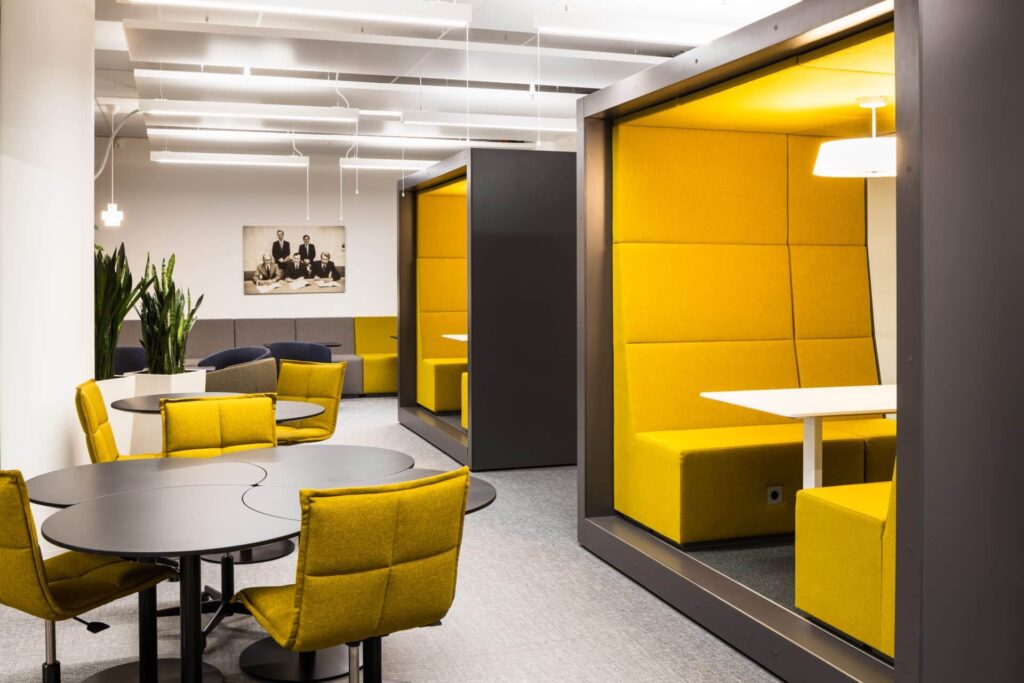
The most effective way to improve office acoustics is to use strategically placed room dividers that absorb and disperse sound. High-quality acoustic elements significantly reduce sound propagation, minimise echoes and create a more peaceful working environment. By placing room dividers in critical locations – such as between workstations and around noisy areas – you can create acoustically pleasant working areas without making permanent structural changes. This approach is both a flexible and cost-effective solution to noise problems in open-plan offices.
Why is office acoustics important for well-being at work?
The acoustic environment in an office has an undeniable impact on employee well-being and performance. Studies show that poor acoustics can reduce productivity by up to 66 per cent, making it a significant factor in the working environment. Constant exposure to distracting background noise raises stress hormone levels, leading to faster fatigue and impaired concentration.
In open-plan offices, employees encounter an average of 87 interruptions per day, and a single interruption can take up to 23 minutes to return to a state of deep concentration. Constant loss of concentration is one of the biggest factors reducing work efficiency in modern work environments.
Background speech is particularly harmful, as it has been found to interfere with cognitive functions significantly more than, for example, steady background noise. For this reason, acoustic solutions for offices have become an important part of workplace wellbeing planning. Studies show that in acoustically well-designed workspaces, employee satisfaction increases by an average of 48 per cent.
What are the most effective acoustic room dividers for offices?
To improve the acoustic environment in your office, we offer a wide range of acoustic room dividers, each of which is suitable for different situations and needs. Freestanding partitions are the most popular solutions due to their easy portability and versatile sound insulation properties. These elements can be flexibly placed between workstations or in open spaces without structural changes.
Table screens attach directly to desks and provide both acoustic protection and visual privacy for employees. They are particularly effective in dense workstation environments where space is limited. The sound absorption capacity of the screens varies depending on the material.
Modular room divider systems such as STORY WALL enable the creation of entire spaces in larger open areas. The advantage of these systems is the possibility to combine different elements and even create room-like spaces for teamwork.
Acoustic POD rooms offer a more comprehensive solution, providing a completely isolated space for work requiring concentration or confidential discussions. Their speech transmission index (STI) is low, ensuring excellent acoustic privacy.
How should room dividers be positioned to achieve optimal acoustics?
Design based on sound sources and reflective surfaces plays a key role in the effective placement of room dividers. First, map out the acoustic environment of the office by identifying the noisiest areas, such as photocopiers, passageways and collaboration areas. Room dividers placed around these areas act as the most effective sound barriers.
Partitions placed between individual workstations, with a minimum height of 120–150 cm, effectively reduce direct speech transmission. Also consider indirect sound paths – sound is easily reflected from hard surfaces such as windows, floors and open ceilings. Strategically placed room dividers can block these sound reflection paths.
In effective acoustic design, room dividers are used to create zones – separating quiet areas that require concentration from busier collaboration areas. The best results are achieved by combining room dividers of different heights and types according to the office layout and functions.
How high should acoustic room dividers be?
The height of room dividers is a critical factor in their acoustic effectiveness. Optimal height of the room divider depends on the intended use and location. When working at sitting height, the room divider should be at least 120-140 cm high so that it extends above the head of a seated person and blocks the direct line of sight.
In standing workstations or areas where people move around, effective sound insulation requires taller room dividers, 150–180 cm. For complete sound insulation, elements taller than 180 cm are needed, but these can make the space feel visually heavy and dark.
In open collaboration spaces, lower dividers (90–110 cm) can be used to dampen sound while still allowing visual contact and collaboration. With the increase in remote working, tall room dividers of at least 160 cm are important for creating an undisturbed sound environment in spaces intended for video conferencing.
When selecting the height, it is important to maintain a balance between acoustic efficiency and spatial openness. Dividers that are too high can make the space feel cramped, while those that are too low do not provide sufficient acoustic protection.
What materials should be favoured in acoustic room dividers?
Among the materials used in acoustic room dividers, felt is one of the most effective sound-absorbing options. High-quality acoustic felt can absorb up to 80% of the sound that hits it. The density of the felt material has a direct impact on its sound insulation properties – denser felt absorbs low frequencies more effectively, which are often the most challenging to dampen.
Partitions made from polyester fibre offer excellent absorption for both high and mid frequencies, and are typically lightweight and easy to clean. Acoustic elements made from recycled PET plastic are an environmentally friendly option that combines good acoustics with sustainability.
When comparing acoustic solutions, the sound absorption coefficient (NRC) is taken into account, which indicates the material's ability to absorb sound. Effective acoustic material has an NRC value of at least 0.7–0.9. In addition to the absorption value, fire safety, cleanability and allergenicity must also be taken into account when selecting materials.
INTO Concept acoustic room dividers is designed to provide optimal absorption capacity while taking into account Nordic design requirements and environmental sustainability.
How to combine visual appearance and acoustics in room dividers?
Acoustic room dividers can be seamlessly integrated into the visual appearance of an office with careful planning. Matching colours and materials with the rest of the office décor to create a cohesive overall look. Partitions can even serve as decorative elements that reinforce the company's brand identity.
Printed surfaces allow graphic elements, images or branded visuals to be added to room dividers without compromising their acoustic properties. Double-sided room dividers can be produced in different colours or textures on each side, allowing different atmospheres to be created in different parts of the room.
Transparent or partially transparent acoustic elements are an excellent option when you want to preserve the space and light in a room, but still need acoustic protection. For example POD ROLL GLASS solutions combine acoustic glass and sound-absorbing structures.
The best design solutions take into account both acoustic needs and visual objectives. For example, INTO Concept's STORY WALL room dividers offer acoustic protection as well as functional surfaces that can be used for work.
Improving office acoustics – a comprehensive approach
Effective office acoustics management is a comprehensive process in which room dividers form a key part of a broader solution. Successful acoustic design begins with mapping out the office's intended use and working methods – different tasks require different acoustic environments.
In addition to room dividers, the comprehensive acoustic solution includes acoustic ceiling panels that prevent sound from reflecting off the ceiling, as well as POD rooms for intensive concentration or meetings. Personalised acoustic solutions, such as taller screens placed at specific workstations, support individual needs.
Acoustics is at its best when it is an invisible part of office design – when it works well, you don't notice it. However, a successful acoustic environment has a significant impact on employee well-being, concentration and productivity. Good acoustic design takes into account both the need for privacy and the need to facilitate collaboration.
INTO Concept's expertise in office acoustics is based on both technical knowledge and experience of different working environments. Individually designed solutions take into account the specific characteristics of the space and the needs of its users.
Take a look at a our references and be inspired by the projects that have been implemented - contact us, and together we will find the solution that suits you best!