








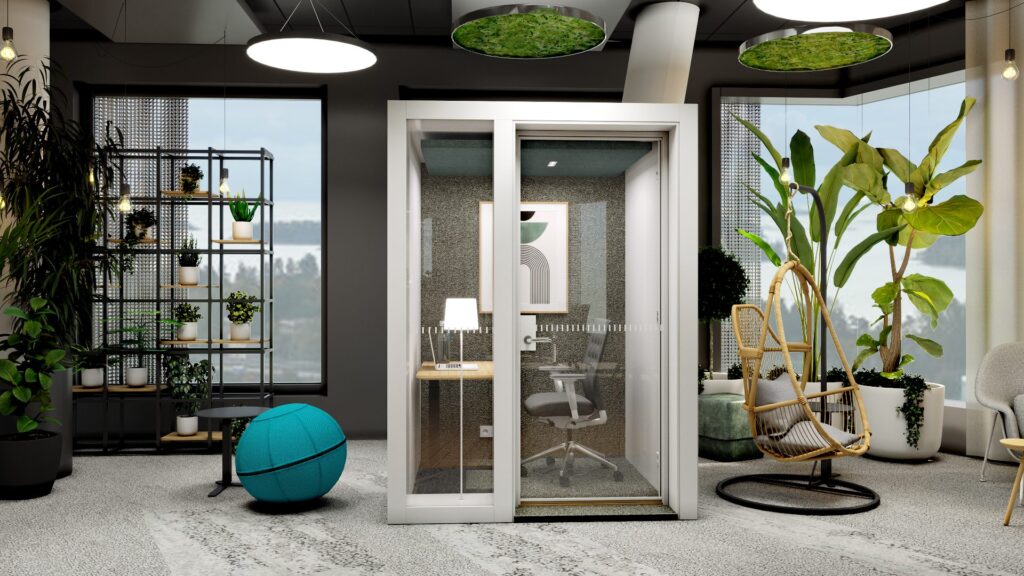
Modern office design balances collaboration and privacy. Integrating quiet workspaces into open environments is a key challenge, which POD facilities offer an effective solution. Successful implementation requires careful planning in terms of acoustics, layout, size and adaptability. By combining ergonomic furniture solutions and partitions with PODs, a functional package is created that supports different working methods and improves well-being.
Why have PODs become so popular in open offices?
The design of office space has changed significantly in recent years. Open-plan working environments have become the norm, but at the same time the number of tasks requiring concentration has increased. This has created a need for quiet workspaces within an open environment.
The transformation of working life is particularly visible in the combination of teleworking and office work. Workers now value spaces that allow them to work in different ways - sometimes collaborative working with colleagues, sometimes in total peace and quiet.
One the main challenges in open offices is acoustic management. Background noise can impair concentration and work efficiency. PODs offer a concrete solution to this problem, acting as a soundproof safe haven in the middle of a busy office.
Workers' expectations of the working environment have changed. Today, the ability to choose the space that suits the job - whether it's teamwork, a client call or a project that requires concentration - is valued. PODs meet this need by offering flexible solutions as part of an open office environment.
How do PODs affect the acoustics of an open office?
The sound environment is one of the most critical factors for office comfort. PODs act as effective sound barriers, limiting the passage of sound in a number of ways. They prevent sound from travelling into surrounding spaces and protect their users from external noise.
Structural sound insulation is a key feature of quality POD facilities. For example, our solutions have achieved an acoustic rating of A (Finnish SFS 5907 standard). This means that the user can have confidential conversations without worrying about sound being carried outside.
The insulation structure of PODs also provides excellent protection against disturbing sounds. This is particularly useful in rooms where telephone conversations are held or video conferencing takes place. A distraction-free environment significantly improves the quality of communication.
In a holistic office environment, PODs are part of a wider acoustic design. They help to divide open areas into functional zones, thereby improving the overall office soundscape. This supports both individual work that requires concentration and teamwork that requires collaboration.
What factors should be taken into account in the layout of PODs?
The optimal layout of PODs is key to creating a functional working environment. Placement should take into account access routes - PODs should be located for easy access but not along the busiest routes. This will minimise distractions and maximise user comfort.
The relationship with other workstations requires careful planning. PODs should be located at a suitable distance from open work areas so that they are easily accessible but do not interfere with the surrounding work. Strategic placement in common areas supports spontaneous use as needed.
Lighting is an important factor in the layout of PODs. Adequate lighting is essential for working comfort. Modern POD spaces, such as our solution, often incorporate motion-sensor LED lighting to ensure an optimal working environment.
Balancing openness and privacy is a key challenge for the layout. POD spaces with glass surfaces create a sense of openness and aesthetic lightness. At the same time, they provide a soundproof space in which to work without interruption. Finding this balance is essential for a functional whole.
How do different sizes and types of PODs serve different work tasks?
In an office environment, different spaces are needed to meet a variety of working needs. Single-person meeting rooms, such as POD PHONE solutions, are ideal for making calls and individual work. They provide a quiet environment in which to work without interruption.
For small group meetings, slightly larger rooms are needed. For example, POD 2 is ideal for one-to-one meetings and small meetings. Versatile meeting spaces allow you to efficient cooperation without disturbing other office staff.
Telephone conversations and video conferences require special acoustic design. PODs with good sound insulation and minimal reverberation greatly improve the quality of communication. This is particularly important in today's working environment where virtual meetings are commonplace.
Different technical and furnishing solutions are necessary to support different work tasks. PODs can be integrated with display stands such as the DISPLAY BOX, which allows you to hide distracting cables and wires. Ergonomic seating and functional desk solutions complete the package according to the requirements of the different work tasks.
How do space dividers and flexible furniture solutions complement the POD concept?
In a holistic office concept, partitions are an essential part of a functional whole. They help to define different areas of activity in an open space without creating solid walls. Space dividers work seamlessly with PODs, offering flexible possibilities for structuring the space.
Seating is an essential part of modern office design. POINT sofas and CUBE solutions offer acoustic seating groups, which allow for spontaneous meetings and informal discussions. This furniture complements PODs by providing alternative working areas for different needs.
Convertible desks and workstations, such as TOP Lift desks, support ergonomic working in both the office and home office. Height-adjustable desks allow you to change your working position during the day, contributing to work well-being and efficiency.
The combination of POD spaces and flexible furniture solutions creates an adaptable working environment that adapts to different situations and needs. This holistic approach to office design supports both individual work and collaboration, improving the performance of the entire work community.
How to design a sustainable and ecological POD solution?
At the heart of sustainable office design are high-quality material choices. The materials used in the construction of PODs have a significant impact on their sustainability and ecology. Our solutions use high quality materials, such as melamine frames, which are durable and do not scratch or dent easily.
Energy efficiency is an essential part of a sustainable POD solution. Motion-sensor LED lights save energy by turning on lights only when needed. Energy-efficient ventilation system ensures fresh air and a comfortable working environment with minimal energy consumption.
Multi-use improves the ecological footprint of PODs. When the same space can be used for several different purposes, the need for separate rooms and furniture is reduced. For example, a POD ROLL can serve as both a conversation space and a place for independent work, maximising the use of space.
The long-term flexibility of PODs is a key factor in sustainable office design. Adaptable solutions that can be modified as needs change reduce the need for constant renovation. This extends the life of the space and reduces the long-term environmental impact.
Key elements for effective POD solutions
The key to successful POD integration is excellent acoustics. Sound insulation and acoustic properties determine how well a space serves its purpose. Class A acoustics ensure that PODs truly enhance the soundscape of the working environment and enable concentration-demanding tasks.
Ergonomics is another critical key element. PODs are complemented by ergonomic furniture that supports correct working postures and promotes well-being at work. Comprehensive ergonomic design covers all aspects of work, from sitting to setting up displays.
Adaptability is essential in modern working environments. PODs, which can be repositioned or reconfigured as needs change, offer long-term value. For example, POD ROLL solutions with wheels allow flexible use of space in different situations.
The overall functionality of a space is achieved when all the elements work together seamlessly. PODs, partitions, seating, desks and workstations work together to create a harmonious whole that supports different ways of working. Practical examples of successful implementations include Valmet's premises in Keilaniemi in Espoo and FIM's multi-space office in the heart of Helsinki.
Take a look at a our references and be inspired by the projects that have been implemented - contact us, and together we will find the solution that suits you best!