








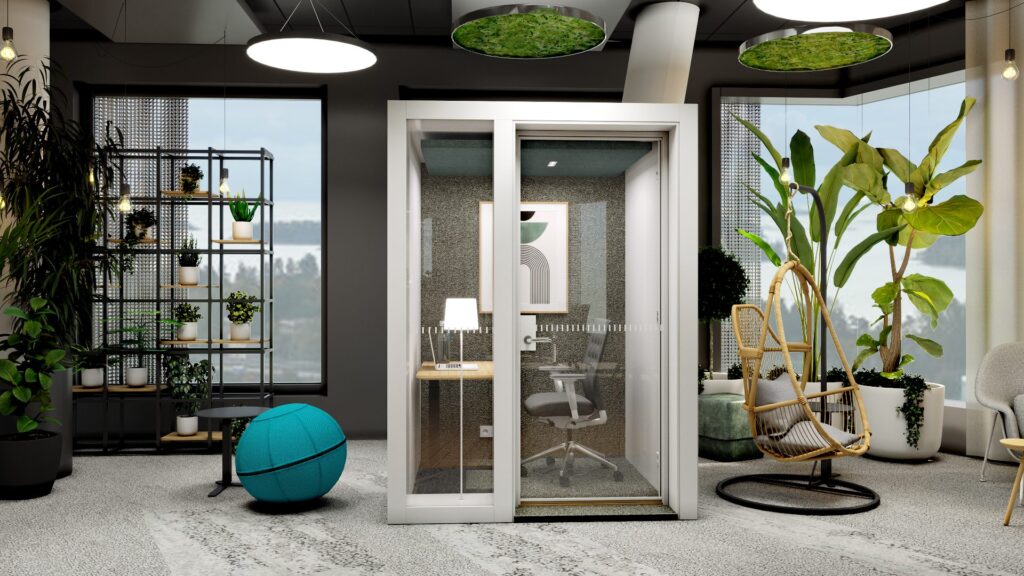
When designing modern workspaces, there are often two options: traditional workstations and more technologically advanced soundproof PODs. The latter stands out with its high-quality soundproofing, technology integrations and more flexible adaptability. Workstations are usually simpler in terms of structure and acoustics, while soundproof PODs are designed specifically to meet the sound control and concentration needs of modern offices.
What is the difference between a workstation cubicle and a soundproof POD?
Workstation cubicle and soundproof POD serve the same basic purpose – to provide employees with a peaceful space for tasks that require concentration. A traditional workstation cubicle is usually a fixed structure that acts primarily as a visual screen and basic sound barrier. Its structure is typically simple and more affordable, but the sound insulation is often modest.
The soundproof POD, on the other hand, is a comprehensive solution that utilises advanced soundproofing techniques. The specially constructed walls, ceilings and doors of the POD are designed specifically for sound control. Material choices, such as acoustic panels and special glass, make POD significantly more effective at sound control.
Workstation booths are generally designed to serve only one person at a time, whereas POD solutions are more versatile. POD rooms are available in various sizes, from single-person telephone booths to meeting rooms for several people. This flexibility makes PODs more suitable for different working environments and varying needs.
In modern office design, understanding these differences is essential, as the nature of work has changed significantly. Increased virtual communication, hybrid meetings and projects that require concentration require spaces that truly support these activities – mere visual privacy is no longer enough.
What are the benefits of a soundproof POD compared to a standard workstation cubicle?
The most significant advantage of a soundproof POD is its superior acoustic performance. Whereas a standard workstation cubicle can dampen sound to some extent, a professionally designed POD can achieve up to Class A sound insulation in accordance with the SFS 5907 standard. This is particularly evident in the speech transmission index (STI), which is only 0.10-0.15 in top-of-the-line POD solutions, meaning that speech outside the booth is almost impossible to understand.
Concentration improves significantly when external noise is blocked out. This is particularly important in open-plan offices, where the soundscape can otherwise be restless. Productivity studies show that focused work can be up to 40% more efficient in a distraction-free environment.
Privacy is another key advantage. Many work tasks, such as confidential phone calls or virtual meetings, require absolute sound insulation. The soundproof POD ensures that conversations cannot be heard outside and that outside noise does not disturb those inside.
Technology integrations are generally more advanced in POD solutions. These may include:
- Integrated ventilation and air exchange system
- Built-in lighting, often adjustable
- Electrical and USB sockets
- Reservation management option
When it comes to adaptability, POD solutions excel. They can be moved, dismantled and reassembled as needed, making them ideal for changing office environments. This flexibility brings significant benefits to employee wellbeing, as the space solution can always be optimised according to current needs.
When should a company invest in soundproof PODs instead of workstation cubicles?
The type of office model is a significant factor in decision-making. Open-plan offices, where noise levels are generally high, benefit particularly from soundproof PODs. Their ability to dampen ambient noise is essential for employees to concentrate and communicate effectively. In hybrid offices, where employees visit irregularly, the adaptability and mobility of PODs bring significant added value.
The size of the company and its growth prospects also influence the choice. For smaller, growing companies, the adaptability of PODs is an advantage, as they can be taken along when moving or their number can be increased as needed. For medium-sized and large companies, the scalability of PODs is optimal – the same solution can be applied throughout the organisation.
The nature of the work often determines the need. If your work involves a lot of virtual meetings, phone calls or tasks that require a high level of concentration, a soundproof POD is clearly the better choice. Tasks that involve handling confidential information, such as human resources or legal matters, particularly benefit from the improved sound insulation offered by PODs.
From a budgetary perspective, it is important to consider the total costs. Although PODs are generally more expensive as an initial investment, their longevity, adaptability and impact on employee well-being and productivity often make them a more cost-effective solution in the long term. In addition, PODs are often completely independent units that do not require any changes to the building's technical systems.
How does the acoustics of a soundproof POD differ from a regular workstation cubicle?
The acoustic properties of soundproof PODs are based on special structural solutions. The walls of PODs usually consist of several layers, often including sound-absorbing materials such as acoustic panels, specially constructed panels and soundproofing membranes. Careful structural design ensure that sound cannot travel through or past the structure.
Soundproof PODs often use special glass, such as glass laminated with a soundproofing film, which blocks sound more effectively than ordinary glass. Workstations often use ordinary glass, which does not block sound very effectively.
In terms of acoustic measurement, top-of-the-line POD solutions achieve Class A sound insulation values in accordance with the SFS 5907 standard. Sound insulation is usually measured in decibels (dB), with a higher number indicating better sound insulation. High-quality PODs can achieve sound insulation of up to 30-35 dB, while workstation cubicles usually achieve less than 20 dB.
The Speech Transmission Index (STI) is a particularly important metric in office environments. STI values range from 0 to 1, with lower values indicating poorer speech intelligibility and therefore better sound insulation. In high-quality PODs, the STI value outside the POD can be as low as 0.10-0.15, which means that it is almost impossible to understand speech.
Reverberation time is also an important factor affecting acoustics. Inside PODs, reverberation time is usually optimised so that speech sounds natural without unwanted echoes. This is achieved through sound-absorbing surfaces and material choices.
How do soundproof PODs and workstation cubicles affect the use of office space?
Soundproof PODs are generally more space-efficient overall solutions. Although their floor area may be slightly larger than that of a simple workstation cubicle, they offer more versatile uses. For example, a 4-6 square metre POD can serve 2-4 people, while a workstation cubicle of the same size can only serve as a workspace for one person.
Placement options are more flexible with PODs. Their modular structure allow for different configurations and work excellently as room dividers in open spaces. The straight lines and minimalist appearance of modern PODs make them easy to place side by side without leaving hard-to-clean spaces between them.
A concrete example of space utilisation: a 100-square-metre open-plan office can accommodate 20–25 workstations without separate quiet areas. The same space can be rearranged to accommodate 15-18 workstations and 3-4 POD solutions (of different sizes), significantly improving overall work efficiency, even though the number of individual workstations is smaller.
PODs bring flexibility to the overall look and feel of an office and its traffic routes. They can be used strategically to structure traffic routes and separate different work areas without fixed wall structures. This improves the visual clarity and navigability of the office.
Furthermore, placing PODs in central locations increases their utilisation rate. When a quiet space is easily accessible, employees are more likely to use it for short-term tasks that require concentration.
What are the ecological differences between soundproof PODs and workstation cubicles?
PODs are often more advanced in their choice of materials. High-quality POD solutions use durable and environmentally friendly materials, such as certified wood, recyclable metals and ecological acoustic panels. The choice of these materials not only affects environmental friendliness but also indoor air quality.
Energy efficiency is a significant advantage of PODs. Modern POD solutions are often equipped with energy-efficient LED lighting and smart ventilation systems that are only activated when the space is in use. This reduce energy consumption compared to traditional workstations that utilise the office's general systems.
From a life cycle perspective, PODs are a more sustainable choice. Their modular structure allows for parts to be replaced and upgraded, which significantly extends the product's service life. In addition, the fact that PODs can be dismantled and reinstalled reduces the need for new purchases when the office changes.
In terms of recyclability, PODs are generally designed with a life cycle approach in mind. The clear separability of parts facilitates the recycling of materials at the end of their service life. Workstation cubicles are often integrated structures, which makes it more challenging to separate materials for recycling.
Several high-quality POD solutions have earned environmental certifications, such as the M1 rating for low emissions, which indicates that they meet strict requirements for indoor air quality. Workstation cubicles rarely have similar certifications.
Acoustic solutions for the workplace of the future – what can we expect?
The integration of smart technology will be a key development trend in acoustic space solutions. Future POD solutions may include automatic sound level sensors that adjust acoustic properties in real time according to the use of the space. They may also be connected to the company's booking systems and analyse utilisation rates to enable optimal placement.
Adaptability is evolving towards increasingly flexible solutions. In the future, we may see modular systems in which the same elements can be used in different configurations – from individual telephone booths to team meeting rooms. This maximise the return on investment and adapts quickly to changing needs.
The growth of hybrid working is also shaping acoustic space solutions. Offices are increasingly becoming centres of collaboration and interaction, requiring different acoustic zones. Soundproof PODs will play a key role in creating these different working zones.
The importance of employee experience is becoming increasingly emphasised. In the future, acoustic solutions will be designed with a comprehensive user experience in mind, including acoustic properties, visual appearance, ergonomics and air quality. Taking individual preferences into account will become increasingly important.
INTO Concept is committed to developing innovative acoustic solutions that meet the challenges of tomorrow's working environments. We understand that well-designed, high-quality soundproof PODs are a key part of modern and future-oriented office design.
Take a look at a our references and be inspired by the projects that have been implemented - contact us, and together we will find the solution that suits you best!