







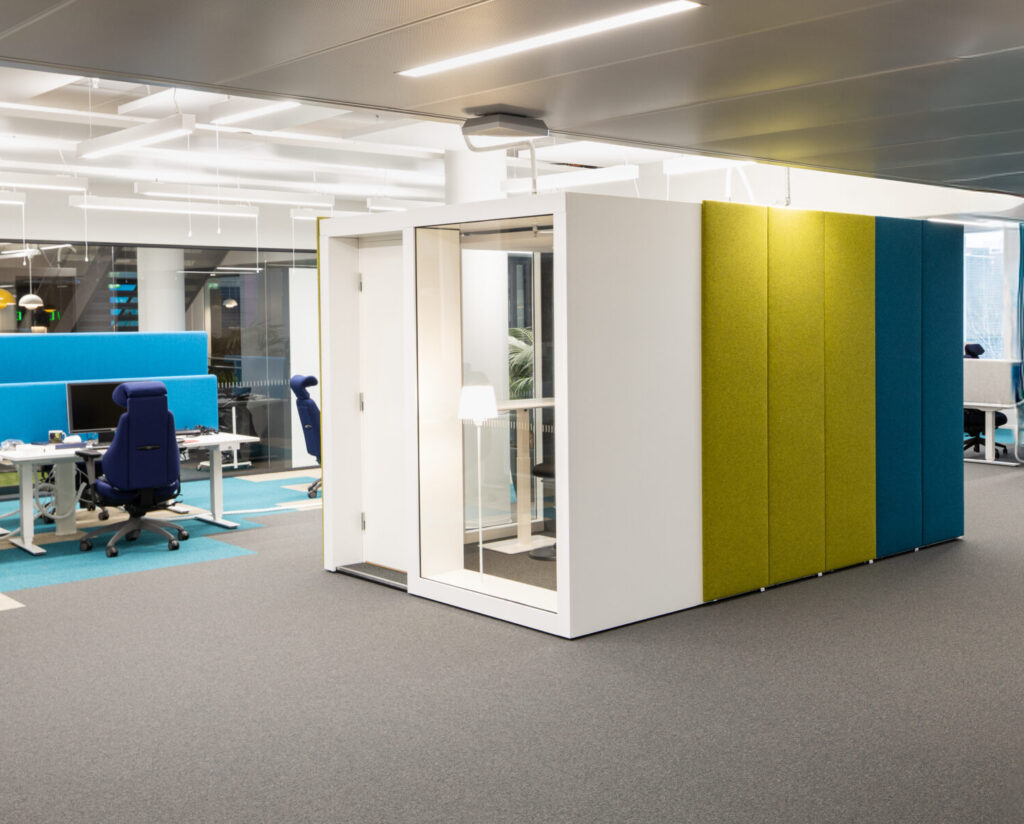
A soundproofed workspace prevents sound from entering and leaving the space, while an acoustic workspace improves the internal sound environment by reducing echo and improving sound quality. Soundproofing protects against external disturbances, while acoustics controls the internal sound conditions of the space. Many modern workspaces combine both features to create a functional working environment.
What does soundproofed workspace mean?
Soundproofed workspace is designed to prevent sound from travelling between the space and its surroundings. The structure is based on materials and structural solutions that stop sound waves from passing through the walls, floor and ceiling. Sound insulation works in both directions: it keeps outside noise out of the space and prevents noise inside the space from disturbing the surroundings.
The structure of a soundproofed workspace consists of several layers that together form an effective barrier to sound. Wall structures include sealed joints, insulation materials and air gaps that block the transmission of sound. Door and window seals are critical points, as even small gaps significantly weaken sound insulation.
Sound insulation is a priority in situations where complete privacy or protection from disruptive external noise is required. Confidential phone calls, video conferences and work that requires concentration benefit from a soundproofed space. In open-plan offices, soundproofed phone booths and meeting rooms enable undisturbed work regardless of the surrounding activity.
What does an acoustic workspace mean in practice?
The acoustic workspace focuses on the quality of the internal sound environment. Acoustic solutions reduce echo and sound reflection from surfaces, improving speech intelligibility and reducing distracting background noise. Good acoustics mean that sound is clear and natural, without metallic echoes or unclear reverberation.
Acoustic materials absorb sound energy rather than reflecting it back into the room. When sound waves hit an acoustic surface, they bind to the material and their energy is converted into heat. This reduces the amount of sound circulating in the room and shortens the reverberation time, which describes how long the sound continues after the original sound source has stopped.
Acoustics are the most important factor to consider in situations where the sound quality within a space is crucial. In meeting rooms, good acoustics ensure that all participants can hear each other clearly. In open-plan offices, acoustic solutions reduce general noise and improve working conditions without complete isolation.
What are the key differences between a soundproofed and an acoustic workspace?
The key difference between these two approaches is their main objective. Sound insulation prevents sound from travelling beyond the boundaries of a space, while acoustics controls the behaviour of sound within a space. A soundproofed space can still have poor acoustics if its interior surfaces reflect sound strongly. Conversely, a space with good acoustics does not necessarily prevent sound from escaping.
The materials and techniques used differ significantly. Sound insulation uses dense, heavy materials and air gaps that block sound waves. Acoustics uses porous, lighter materials that absorb sound energy. Quiet workspace often arises from a combination of both of these characteristics.
The intended uses also reveal a significant difference. Sound insulation is essential when privacy or protection from external disturbances is required. Acoustics are important when you want to improve the comfort of a space and the quality of communication. Modern work environments often need both: structures that protect against external noise and an internally pleasant sound environment.
How do you choose the right solution for your workspace?
Choosing the right solution starts with assessing your workspace needs. Ask yourself: do you need complete privacy for confidential discussions, or is reducing general noise sufficient? Is the problem external noise or internal echo? Your answers will guide you towards the right solution.
If you need protection from external noise or want to prevent conversations from being heard outside, select soundproofed workspace. This is ideal for phone calls, video conferences and confidential discussions. If, on the other hand, your goal is to improve the internal sound quality of an existing space and reduce disruptive echoes, acoustic solutions are the primary choice.
In practice, the best results are often achieved by combining both approaches. We offer POD rooms and telephone booths that combine effective sound insulation with high-quality internal acoustics. These solutions provide both privacy from external disturbances and a pleasant sound environment inside the space, making them versatile options for a variety of working needs in open-plan offices and other work environments.
The final choice depends on your working methods, the intended use of the space and your budget. Assess how often you need complete silence and how many people will be using the space at the same time. These factors will help you determine whether you need a single-person phone booth, a smaller meeting room, or a larger solution for a bigger group.