








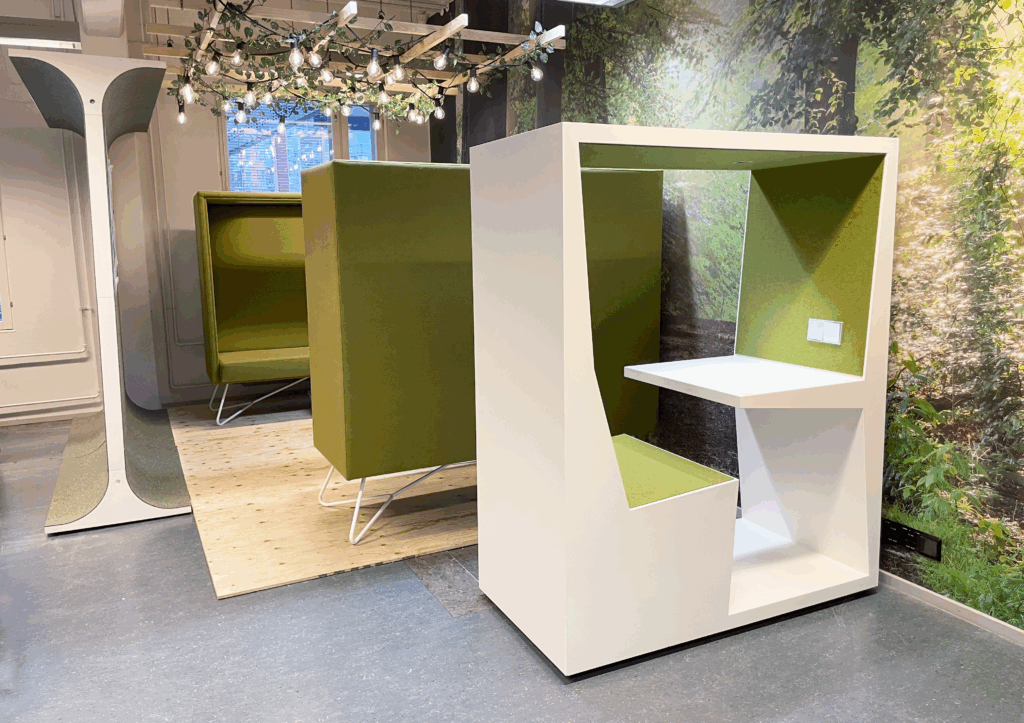
A soundproofed room requires special furniture to support sound absorption and prevent interference. Furnishing an office in a soundproofed space focuses on acoustic properties and material choices that minimise sound transmission and reverberation. The right furniture improves both sound insulation and comfort in the working environment.
What is a soundproofed room and why does it need special equipment?
The soundproofed room is designed to minimise the sound traveling in and out of the room. Ordinary furniture is not enough to achieve optimum sound insulation, as hard surfaces reflect sound and thin materials allow sound to pass through easily.
Special equipment is needed because the acoustic requirements of a soundproofed room are significantly different from those of a normal room. The room needs furniture that absorbs sound instead of reflecting it. In addition, the furniture must be sufficiently dense and heavy to prevent sound propagation.
Furnishing an office in a soundproofed space requires careful planning. Every piece of furniture affects the acoustic properties of the space, and the wrong choices can significantly reduce sound insulation. This is why specialised solutions are needed that combine functionality with acoustic requirements.
Which types of furniture best improve the sound insulation of a room?
Soft and dense furniture work best in a soundproofed room. Acoustic panels, densely padded seats and heavy desks effectively absorb sound and prevent it from being reflected.
Seating should be chosen from dense foam and thick covering material. These absorb sound better than hard chairs or benches. Desks and workstations benefit from heavy materials that do not vibrate easily under the influence of sound.
Space dividers are particularly important in a soundproofed room. They can provide additional insulation and significantly improve the acoustics of a room. Acoustic partitions combine functionality and sound absorption effectively.
POD rooms or office cubicles offer ready-made solutions with pre-designed acoustic features. These structured solutions often work better than combinations of individual pieces of furniture.
How do you choose the right materials for furniture in a soundproofed room?
The choice of materials is based on acoustic properties and density. Soft, porous materials absorb sound, while hard surfaces reflect it. Optimal sound insulation is achieved by strategically combining different materials.
Fabrics and textiles work well for sound absorption, especially when they are thick and dense enough. Avoid shiny surfaces and instead choose materials with a matte finish that do not reflect sound as strongly.
Filling materials play a major role. High-quality acoustic foam or mineral wool works better than ordinary infills. These materials are specifically designed for sound absorption and absorb sound over a wider frequency range.
Combining materials is the key to success. A heavy frame, acoustic infill and a suitable cover fabric create a powerful combination. Each layer increases sound absorption and improves the acoustic properties of the space.
How much does it cost to furnish a soundproofed room?
Furnishing a soundproofed room costs 30-50 % more than furnishing a normal space because of the special materials and design. However, the investment pays off in terms of improved working peace and productivity.
Pricing is influenced by the quality of materials, the size of the space and the level of acoustic requirements. Special acoustic materials are more expensive than standard options, but are essential to achieve good sound insulation.
Cost-effective alternatives can be found through thoughtful planning. By focusing on the main acoustic problem areas, a good result can be achieved at a reasonable cost. A phased approach allows the budget to be spread over a longer period.
The long-term value comes from an improved working environment and reduced disruption. Furnishing an office with the right acoustic solutions improves employee concentration and reduces stress, which ultimately translates into higher quality and efficiency.