








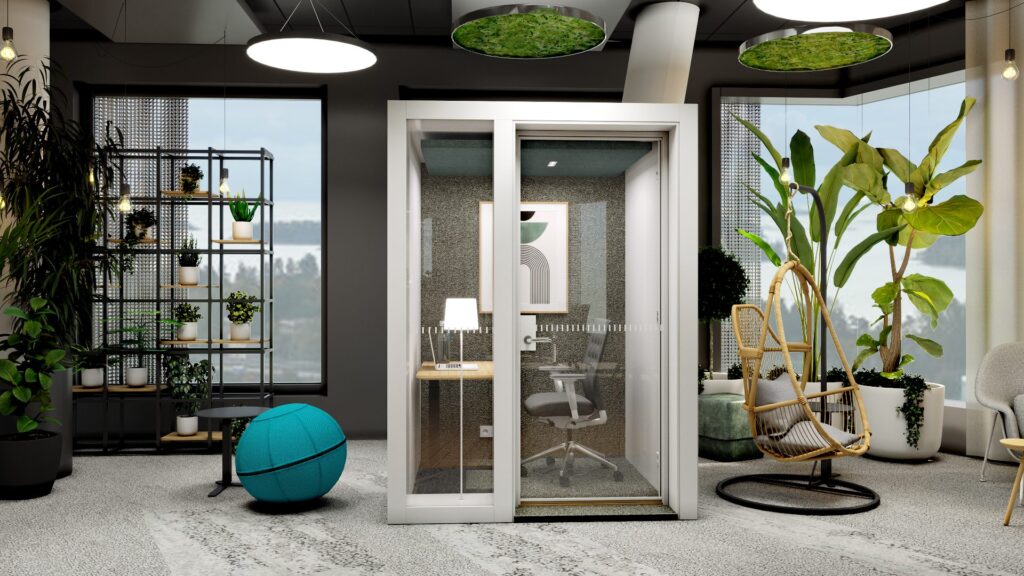
The modern office environment requires spaces that support employee well-being and productivity. The ergonomic POD space offers a comprehensive solution that combines adjustable elements, optimised acoustics, thoughtful lighting and high-quality materials. These spaces enable efficient and comfortable working, both individually and in groups, minimising physical strain and maximising concentration. The ergonomics of the working environment is a whole, where every detail affects the user experience.
What are the most important features of an ergonomic POD room?
The physical and mental well-being of the user is central to an ergonomic working environment. In a high-quality POD solution, ergonomics is achieved through a combination of several different features that take into account people's natural needs and movements.
The most important feature is versatile adjustability. Height-adjustable desks, such as those in the TOP Lift series, enable users to work in an ergonomic position regardless of their height. This allows them to vary their working position throughout the day, which is essential for their health.
Sturdy and comfortable seating furniture is another important factor. Well-designed seats, such as those in the POINT series, support the spine and enable a good working posture even during longer meetings. This reduces lower back pain and improves concentration.
Lighting has a direct impact on ergonomics. LED lights integrated into POD rooms provide even, eye-friendly lighting that prevents eye strain and improves work efficiency. Smart motion sensors ensure that lighting is energy-efficient and automatic.
Acoustic solutions are at the heart of POD room ergonomics. Sound insulation structures, acoustic panels and high-quality materials significantly reduce background noise, which is one of the biggest factors affecting work efficiency and well-being in an office environment.
Seamless integration of technology is essential in a modern working environment. The ergonomic POD room has been designed with easy access to power sockets and network connections, so that technology supports your work rather than getting in the way.
How does a POD room improve working ergonomics in an open-plan office?
Open-plan offices have become more common due to their collaborative nature, but they also present challenges in terms of ergonomics. POD rooms are an effective solution to these problems, enabling both concentration and interaction.
POD rooms offer privacy, which is often lacking in open-plan offices. Privacy is not only a comfort factor but also an ergonomic factor, as the feeling of being constantly observed increases stress and physical tension. Inside a POD room, employees can concentrate on their work without constant disruption.
Another significant advantage is sound insulation. POD rooms, such as POD 2 and POD MAX, are designed to dampen external noise and prevent conversations from being heard outside. This reduces the cognitive load that arises when the brain has to constantly filter out irrelevant sounds.
POD rooms also enable employees to maintain an ergonomic working posture even during long periods of work. In open-plan offices, employees may consciously or unconsciously adopt unergonomic postures in an attempt to create privacy. In a POD room, you can work in a natural and supportive position.
In addition, POD rooms offer a flexible solution for a variety of tasks. The same space can serve as both a quiet place to concentrate and an effective meeting room, which increases the versatility and comfort of the working environment.
How does acoustics affect the ergonomics of a POD room?
Acoustics is a key factor in workplace ergonomics, directly affecting human cognitive functions and well-being at work. The acoustic solutions in POD rooms are designed to meet these needs.
The soundscape of the working environment has a significant impact on concentration. Even small, repetitive sounds can interrupt your train of thought and distract you from your work. The soundproofing of POD rooms has been achieved using special structures that effectively absorb sound. For example POD PHONE SMALL BASIC model The sound insulation value and sound rating are class A according to the Finnish SFS 5907 standard.
Acoustic panels on the walls and ceiling of POD rooms not only dampen external noise, but also improve the internal acoustics of the space. This makes video conferences, for example, clearer and less stressful, which is important as remote collaboration becomes more common.
Good acoustics also reduce cognitive load. When background noise is reduced, the brain can focus on processing essential information instead of expending energy on filtering out distracting sounds. This reduces fatigue after the working day and improves work efficiency.
Modular acoustic solutions for POD rooms, such as removable and easily attachable POD panels, allow the acoustics to be adjusted as needed, making the space more versatile and better suited to different ways of working.
What materials are used in the manufacture of an ergonomic POD room?
Material choices play a key role in the design of ergonomic POD rooms. The materials used have a direct impact on user comfort, indoor air quality and the longevity of the solution.
High-quality, durable wood materials are often used as the framework for POD rooms. Natural materials not only bring warmth and comfort to the space, but also have a positive effect on the acoustics. INTO Concept's POD rooms, for example, use high-quality MDF surfaces, which are durable and versatile materials.
Special absorbent materials, such as Gabriel SOUL acoustic panels, are used to improve acoustics. These materials reduce echo and absorb sound, creating a peaceful working environment. The ability of materials to absorb and dampen sound is key to ergonomics.
Laminated safety glass with improved acoustics acts as both a visual barrier and sound insulation. The glass also brings a sense of space and transparency to the room, which is especially important when working in small spaces.
During manufacturing, special attention is paid to the impact of materials on indoor air quality. POD rooms have an automatic ventilation system that ensures a constant supply of fresh air. High-quality materials also prevent harmful chemicals from entering the air, which could cause health problems.
Ecological considerations are an important part of material selection. Materials that comply with the principles of sustainable development support a responsible working environment and are often user-friendly and durable.
How do POD rooms complement other office furniture in an ergonomic working environment?
A comprehensive ergonomic working environment is created through the interplay of different furniture solutions. POD rooms play a key role in this, complementing other office furniture and creating versatile working environments.
POD rooms and space dividers work together to create different zones within an open space. Space dividers can guide traffic to POD rooms and create visual order, which improves spatial perception and reduces cognitive load. Together, they form tranquil islands in the middle of the open space.
Seating are an essential part of the ergonomic whole. POD rooms can be furnished with different types of seating depending on their intended use, such as POINT series sofas for more relaxed working or meetings. Correctly chosen seating supports an ergonomic working posture in different situations in the POD room.
Tables and workstations complement the functionality of the POD room. Height-adjustable tables enable working in different positions, which is an important part of dynamic ergonomics. INTO Concept's TOP Lift tables are an excellent choice for POD rooms, as they are visually elegant but structurally sturdy.
Together, these elements create a comprehensive ergonomic working environment that takes into account both physical and mental well-being. The POD room functions as a multi-purpose space that adapts to different needs and working styles.
The future of ergonomic work environments – the role of POD rooms
The development of working environments is constantly changing, and flexible solutions such as POD rooms play a key role in the design of future workplaces. As hybrid working becomes more common, the need for adaptable and ergonomic spaces will continue to grow.
POD rooms are the answer to the challenges of modern working life, offering a balance between privacy and collaboration. They enable tasks that require concentration and confidential discussions, while the surrounding open space supports community spirit and spontaneous interaction.
In the future, the technological integration of POD rooms is likely to become more advanced. Smart solutions such as automatic ventilation, motion-sensor lighting and integrated booking systems will further improve the user experience and efficiency. These technological solutions support ergonomics by reducing unnecessary cognitive load.
As practical tips for improving office ergonomics, we recommend creating a versatile space where POD rooms provide peaceful working environments for different needs. Smaller POD PHONE telephone booths are suitable for one-on-one conversations, POD 2 meeting rooms for meetings of 1-4 people, and POD MAX for larger meetings.
Ergonomics is a comprehensive issue that directly affects well-being and productivity at work. When designing office space, it is important to consider both physical ergonomic factors (furniture, lighting) and cognitive factors (noise, concentration). POD rooms offer a solution to both of these issues in one package.
Take a look at a our references and be inspired by the projects that have been implemented - contact us, and together we will find the solution that suits you best!