








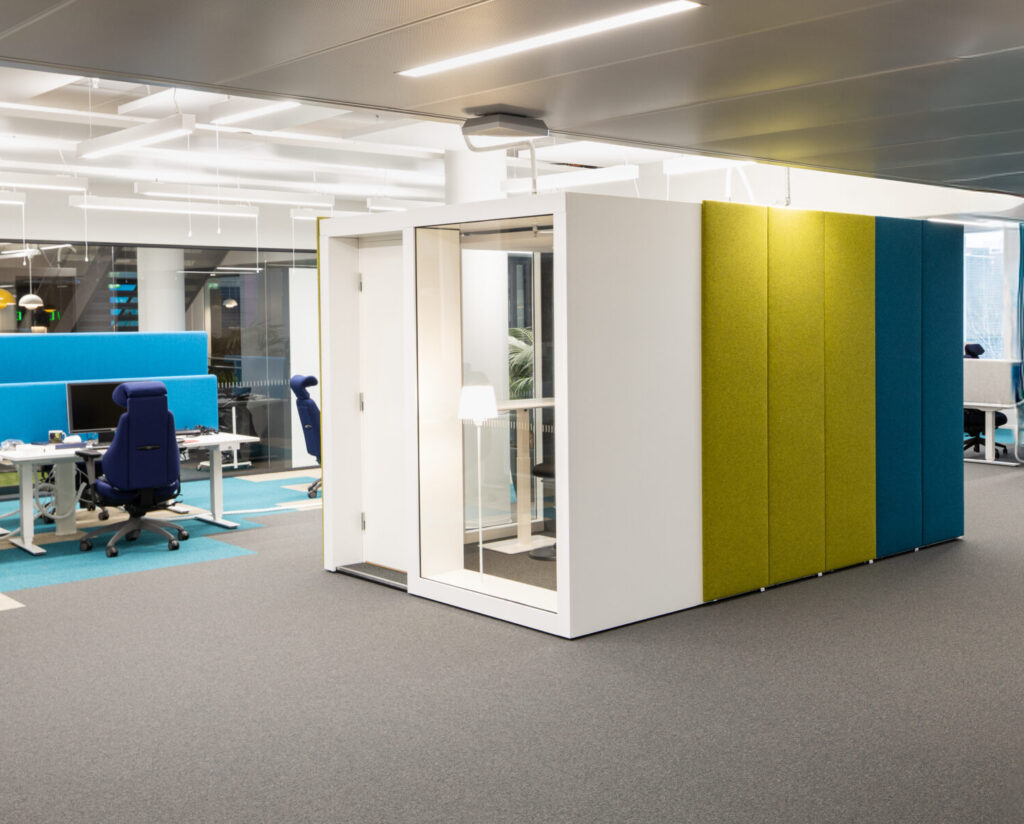
An acoustic workstation is a workspace designed specifically for sound insulation and noise reduction, offering privacy and peace in open-plan office environments. A standard workstation, on the other hand, is a traditional open workstation without acoustic elements. An acoustic workstation utilises sound-absorbing materials and structures that reduce background noise and prevent sound from spreading, while a standard workstation only provides a basic workspace without any special sound protection.
What is meant by an acoustic workstation?
An acoustic workstation is a workstation with integrated soundproofing and noise reduction solutions to improve the quality of work. It consists of materials designed for sound absorption, such as felt or other acoustic coatings that effectively absorb sound. Structurally, an acoustic workstation may include high walls, a ceiling or completely enclosed elements that create a private space within an open-plan office.
Acoustic materials work by dampening and dispersing sound so that it does not reflect back into the room or spread into the environment. For example, felt-covered structures absorb speech and other noise, which significantly reduces distractions. An acoustic workstation can be either semi-open solution, where higher walls provide both acoustic and visual protection, or a completely enclosed space that isolates sound almost entirely.
A key factor in the design of an acoustic workstation is the speech transmission index, which measures the intelligibility of speech outside the space. A low speech transmission index means that conversations inside the space cannot be clearly heard outside, enabling confidential matters to be discussed. The materials used in the structure have been specifically selected for their sound-absorbing properties and form an effective barrier to sound transmission.
How does a standard workstation differ from an acoustic workstation?
A standard workstation is a basic workstation with a desk, chair and possibly a low screen or partition. It lacks special soundproofing, acoustic materials and structural solutions that would reduce noise or provide privacy. In an open-plan office, a standard workstation exposes the user to all ambient sounds, such as colleagues talking, telephone conversations and other office noise.
The difference between an acoustic workstation and a standard workstation is most clearly visible sound insulation and privacy. While sounds travel freely in a standard workstation, an acoustic workstation effectively absorbs and disperses sound. The choice of materials differs significantly: an acoustic workstation utilises sound-absorbing surfaces and structures, while a standard workstation uses standard furniture without acoustic properties.
Structurally, a standard workstation is open and easily accessible, but at the same time susceptible to all environmental disturbances. An acoustic workstation, on the other hand, creates a physical and acoustic barrier that separates the user from the rest of the office. Visual protection is also a significant difference: at a standard workstation, colleagues can easily see your screen or interrupt your work, while an acoustic workstation offers a more private space for concentration.
A standard workstation is suitable for general office work where disturbances are not a critical issue. An acoustic workstation is designed for situations where peace and concentration are essential. Naturally, there is also a difference in price: an acoustic workstation is an investment that costs more than a standard workstation, but in return offers a significantly better working environment.
When should you choose an acoustic workstation instead of a standard one?
An acoustic workstation is the best choice in situations where your work requires concentration, privacy or quiet. Telephone work is a typical example: if you make several calls a day, you need a space where your conversations do not disturb others and background noise does not disturb you. An acoustic workstation enables high-quality telephone conversations without you having to worry about ambient noise or colleagues overhearing confidential matters.
Tasks that require concentration, such as analytical work, writing, design or programming, benefit significantly from an acoustic workstation. In an open-plan office, constant interruptions and background noise impair concentration and slow down work progress. Individual workstations offer peace and quiet, allowing you to immerse yourself in demanding tasks without external distractions.
Confidential discussions and negotiations require a space where privacy is guaranteed. Personnel matters, customer information, or strategic plans should not be overheard by the entire office. An acoustic workstation with a low speech transmission index ensures that conversations remain private. A standard workstation does not offer this protection, and sensitive information may be inadvertently shared within the organisation.
In a disruptive work environment with a lot of traffic, background noise or other noise, an acoustic workstation is essential for maintaining productivity. If you find that your concentration is constantly being disrupted or that background noise is causing your tasks to take longer than they should, an acoustic workstation is the solution. It is also suitable for situations where you need a temporary escape during busy projects or deadlines.
What are the key benefits of an acoustic workstation in the workplace?
An acoustic workstation significantly reduces noise levels by absorbing and dispersing sounds that would otherwise spread freely in an open space. When speech and other noise are absorbed by acoustic materials, the working environment becomes quieter for everyone. This effect is achieved because sounds are not reflected back into the space from surfaces but are effectively absorbed by acoustic elements.
Your ability to concentrate improves significantly when external distractions are reduced. An acoustic workstation creates a protective bubble where you can focus on your tasks without constant interruptions. This leads to tasks are completed faster and higher quality, as you don't have to return to the task again and again after losing concentration. Demanding cognitive tasks in particular benefit from an undisturbed environment.
Productivity increases as a natural consequence of improved concentration and fewer distractions. When employees can perform their tasks efficiently without delays caused by background noise, the quantity and quality of their work improves. An acoustic workstation also allows for better use of time, as there is no need to search for a quiet space or wait for a turn in the meeting room to make a phone call.
Stress is reduced when the working environment supports work rather than being a constant challenge. Constant noise and disturbances strain the nervous system and cause fatigue. An acoustic workstation provides a place where you can work in peace and recover for a moment from the hustle and bustle of an open-plan office. This has a direct impact on well-being at work: when the working environment is pleasant and supports concentration, work feels less stressful and working days are more bearable.
Acoustic workstations also improve the sense of privacy, which is an important part of well-being at work. When you can make phone calls or work without feeling that everyone is watching your every move, your sense of security increases. Visual protection combined with acoustic insulation creates a space where you can truly focus on your work without having to be constantly alert to your surroundings.