








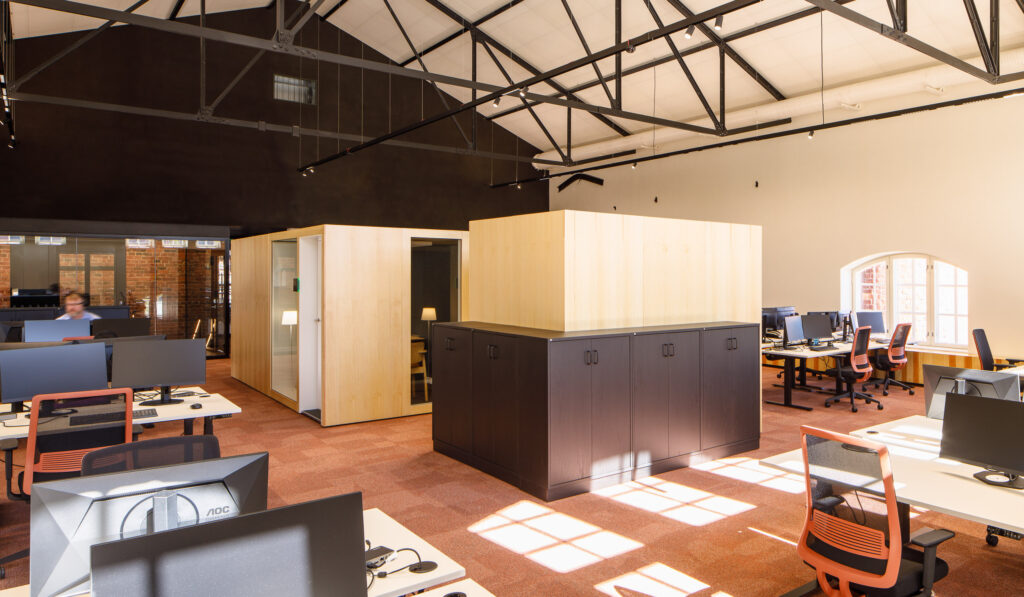
Why is it worth taking confidential discussions in the office into account right from the planning stage?
There’s a lot going on at the same time in a multi-purpose office. One employee is taking part in a video conference, another is chatting to a colleague, and a third is trying to concentrate on a demanding task.
Most conversations do not require any special protection. Some, however, do.
Such situations include, for example, discussions between a line manager and an employee, recruitment interviews, HR matters, customer data, financial matters and legal negotiations.
If there is no suitable space available, a private conversation may end up taking place in a standard meeting room, in a corridor or even at the edge of an open-plan office. From the user’s point of view, this is not an ideal solution.
That is why it is worth recognising the need for privacy before the problem becomes apparent in everyday life.
Speech privacy is not the same thing as good office acoustics
The acoustics in an office may generally be good, even if a single conversation can still be heard too clearly at a neighbouring workstation.
This is because acoustic comfort, absorption, sound insulation and speech intelligibility mean different things.
Sound absorption reduces the reflection of sound off surfaces. It can make a space sound quieter and reduce reverberation.
Sound insulation refers to the amount of sound that is transmitted through a structure into another space.
Speech intelligibility relates to whether an outsider can understand the content of a conversation.
Good sound absorption does not, therefore, guarantee a private conversation. It is therefore advisable to distinguish between the intended uses of an enclosed workspace and open, acoustically absorbent furniture.
What about visual privacy?
Privacy does not always mean silence.
Sometimes the problem is that an employee’s workstation is constantly in plain view of everyone, or that the movement going on around them makes it difficult to concentrate.
A tall piece of furniture, a curtain or a room divider can help reduce visual distractions and create a more private workspace.
This is visual privacy.
However, this does not automatically imply privacy of conversation. An open room divider does not enclose a conversation in the same way as a closed space does.
When is a soundproofed workspace required?
If the content of the conversation is confidential, it is private soundproofed workspace . consultation room may be an appropriate solution.
A phone call or video meeting involving just one person usually requires a different kind of space to a conversation between two or four people.
Phone booths provide a private space for one person to make phone calls and hold video conferences.
Larger meetings naturally require more space, but the number of people alone is not the only deciding factor. The furniture, technology and nature of the meeting all affect the space required.
A telephone booth in the office is not a one-size-fits-all solution
A telephone booth in the office is extremely useful when an individual employee needs a quiet space to make a phone call or hold a video conference.
It may also reduce the number of long phone calls made in an open-plan office.
However, a telephone booth is no substitute for a space where two people can talk or a meeting room.
Similarly, an acoustic partition is not a substitute for an enclosed space when the confidentiality of a conversation is a key requirement.
A good working environment is usually made up of several rooms of different sizes.
Location also matters
Even a well-designed, enclosed workspace may not necessarily feel private to the user if it is situated in the middle of the busiest area.
For example, the room used for staff appraisals may feel uncomfortable if you have to wait next to a large break room or a main corridor.
That is why, when planning, it is worth giving as much thought to the location of the space as to the product itself.
Where is the user waiting? Who can see into the room? Are there workstations nearby? Do people walk past the room all the time?
These are minor issues in the layout, but they can be crucial in terms of the user experience.
A variety of spaces are needed for confidential discussions
A single meeting room does not, as a rule, resolve every situation.
A well-designed space may include telephone booths for one person, meeting rooms for two people, and larger conference rooms.
A meeting room of this size is not constantly booked for individual calls, and there is a suitable space close to the workstations for brief private discussions.
The number of rooms should be based on actual usage. If one person makes a lot of calls, more small rooms are needed for them. If, on the other hand, staff or client meetings are constantly held one-to-one, the need for two-person rooms becomes more apparent.
A common mistake is to address privacy concerns too late
The lack of privacy is often only noticed whilst using the device.
In such cases, the meeting rooms are constantly booked, staff are on the lookout for quiet corners, and sensitive discussions take place in areas not intended for that purpose.
This can be avoided by identifying needs at the planning stage.
How many people take part in confidential discussions? How often do they take place? Is video technology required? Is a space for one person sufficient, or are solutions for two or more people needed?
These questions will take you a long way.
Plan your range of spaces according to your needs
An office doesn’t have to be quiet everywhere. What’s more important is that there’s a suitable space for different situations.
In an open-plan office, communal areas, quiet zones, telephone booths and meeting rooms may all be located side by side.
When the range of spaces reflects actual usage, staff do not have to keep thinking about where a particular conversation can take place.
Discover our acoustic workspace solutions . contact us, if you wish to compare options of different sizes as part of planning your workspace.